Hydrogen Bromide → 1-[(1H-Pyrrol-2-yl)methylidene]pyrrolidin-1-ium bromide
Reaction equation

[BrH:1].[NH:2]1[CH2:6][CH2:5][CH2:4][CH2:3]1.[NH:7]1[CH:11]=[CH:10][CH:9]=[C:8]1[CH:12]=O.Br.N1CCCC1>C(Cl)(Cl)Cl>[Br-:1].[NH:7]1[CH:11]=[CH:10][CH:9]=[C:8]1[CH:12]=[N+:2]1[CH2:6][CH2:5][CH2:4][CH2:3]1Participants
6





Procedure
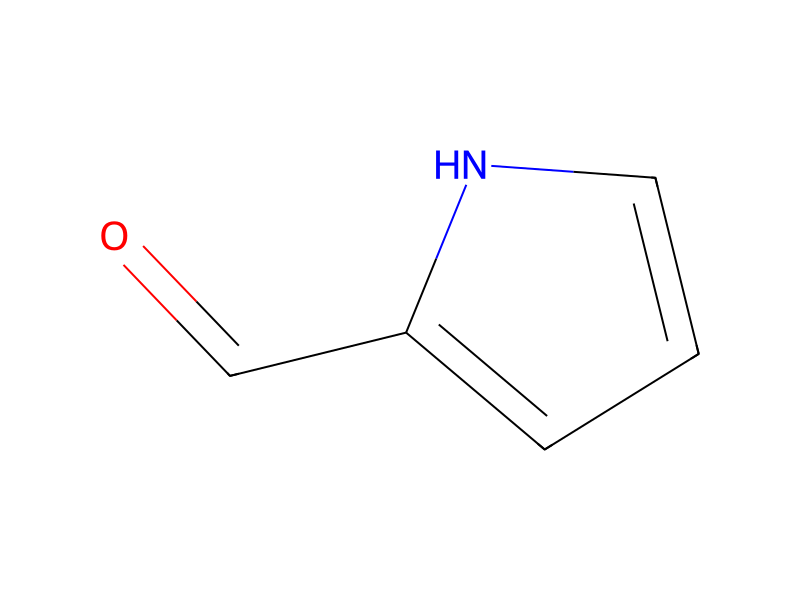
To a solution of 81.0 g (1.00 mole) of hydrogen bromide in 1000 ml of absolute chloroform is added dropwise with cooling and stirring a solution of 80.0 g (1.12 mole) of pyrrolidine in 100 ml of absolute chloroform. Then 95.1 g (1.00 mole) of pyrrole-2-carboxaldehyde is added to the above pyrrolidine hydrobromide solution along with 1 pound of Linde Molecular sieve 5A. The reaction mixture is stirred at ambient temperature for 3 hours, then is filtered through filter aid, washing well with chloroform. The combined filtrate and washings are evaporated in vacuo and the residue is recrystallized twice from acetonitrile to give 1-(pyrrol-2-ylmethylene)pyrrolidinium bromide; m.p. 113°-116° C.
Workup
- temperaturewith cooling
- filtrationis filtered
- filtrationthrough filter aid
- washwashing well with chloroform
- customThe combined filtrate and washings are evaporated in vacuo
- customthe residue is recrystallized twice from acetonitrile
Sources & evidence
- ORD record
- ord-3162f48fa66f4d33bf3d44dfc2dae8d9
- Source dataset
- uspto-grants-1977_09
- Patent number
- US04048191
Reaction notes
Loading…