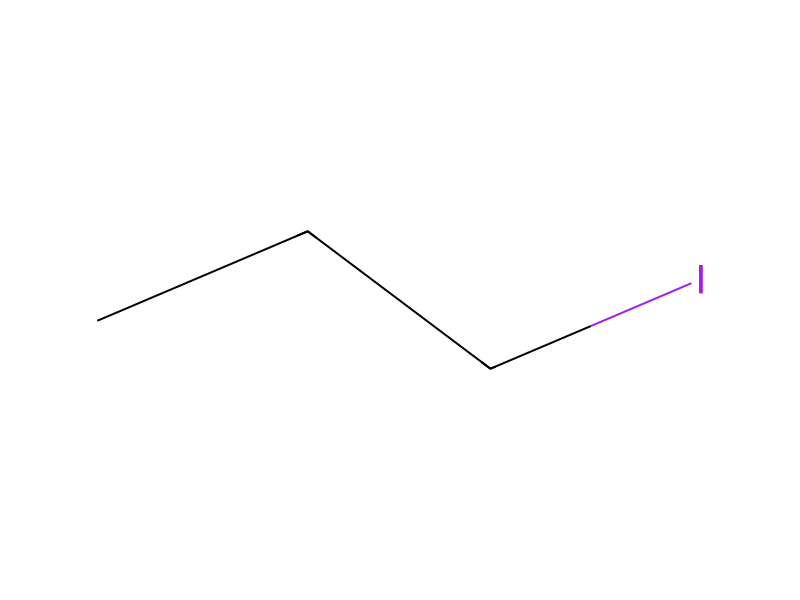
1-Iodopropane → Ethyl 1-propylcyclobutane-1-carboxylate
Reaction equation

[CH:1]1([C:5]([O:7][CH2:8][CH3:9])=[O:6])[CH2:4][CH2:3][CH2:2]1.[CH:10]([N-]C(C)C)([CH3:12])[CH3:11].[Li+].ICCC>C1COCC1.CS(C)=O>[CH2:8]([O:7][C:5]([C:1]1([CH2:11][CH2:10][CH3:12])[CH2:4][CH2:3][CH2:2]1)=[O:6])[CH3:9]Participants




Procedure
Ethyl cyclobutanecarboxylate 1 (25.0 g, 0.195 mol) was added to a solution of lithium diisopropylamide (97.5 mL of a 2.0M solution in THF, 0.195 mol) in THF (200 mL) at −78° C. After 30 min the reaction solution was warmed to room temperature and transferred via cannula to a solution of 1-iodopropane (49.7 g, 0.293 mol) in DMSO (104 mL) while maintaining the temperature between 15-20° C. After stirring for an additional 30 min the precipitated salts were removed by vacuum filtration. The filtrate was concentrated in vacuo, diluted with hexane and washed with 1 N HCl, saturated aqueous NaHCO3 and brine. The organic portion was dried (MgSO4), filtered and concentrated in vacuo. The residue was purified by vacuum distillation (105-108° C., 20-30 mmHg) to give 16 g (48%) of the ester 2 as a clear, colorless oil.
Workup
- temperaturewhile maintaining the temperature between 15-20° C
- customwere removed by vacuum filtration
- concentrationThe filtrate was concentrated in vacuo
- additiondiluted with hexane
- washwashed with 1 N HCl, saturated aqueous NaHCO3 and brine
- dry with materialThe organic portion was dried (MgSO4)
- filtrationfiltered
- concentrationconcentrated in vacuo
- distillationThe residue was purified by vacuum distillation (105-108° C., 20-30 mmHg)
Sources & evidence
- ORD record
- ord-15761b5f99644c2b93179d2e0498786c
- Source dataset
- uspto-grants-2011_04
- Patent number
- US07932420B2
Reaction notes
Loading…