2-Bromoethanol → HCID 28603857, compound
Reaction equation

[F:1][C:2]1[CH:3]=[C:4]([CH:7]=[CH:8][C:9]=1[OH:10])[CH:5]=[O:6].Br[CH2:12][CH2:13][OH:14].C(=O)([O-])[O-].[K+].[K+]>CN(C=O)C>[F:1][C:2]1[CH:3]=[C:4]([CH:7]=[CH:8][C:9]=1[O:10][CH2:12][CH2:13][OH:14])[CH:5]=[O:6]Participants
5
Reactant 3


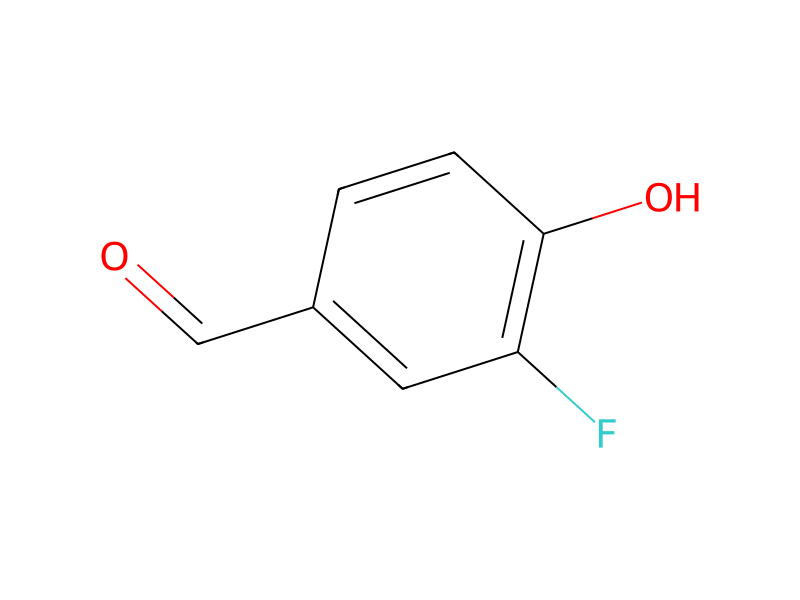
Product 1

Reagents, catalysts & solvents 1

Conditions
- Temperature
- 150 °C
Procedure
5.00 g (35.69 mmol) of 3-fluoro-4-hydroxybenzaldehyde are dissolved in 50 ml of dry DMF. 5.35 g (42.82 mmol) of 2-bromoethanol and 19.73 g (142.74 mmol) of potassium carbonate are added. The reaction mixture is stirred at 150° C. for 10 h. The mixture is then filtered, and the filtrate is freed from the solvent on a rotary evaporator. The residue is taken up in 30 ml of ethyl acetate, and 20 ml of sat. aqueous sodium bicarbonate solution are added. The phases are separated and the organic phase is dried over magnesium sulfate. The solvent is removed on a rotary evaporator. The product obtained is used without further purification in the subsequent reaction.
Workup
- filtrationThe mixture is then filtered
- customthe filtrate is freed from the solvent on a rotary evaporator
- addition20 ml of sat. aqueous sodium bicarbonate solution are added
- customThe phases are separated
- dry with materialthe organic phase is dried over magnesium sulfate
- customThe solvent is removed on a rotary evaporator
- customThe product obtained
- customis used without further purification in the subsequent reaction
Sources & evidence
- ORD record
- ord-ad54c1fa507f44b89718fe9358f6dbc3
- Source dataset
- uspto-grants-2013_05
- Patent number
- US08440700B2
Reaction notes
Loading…