Sodium Cyanide → 2-Deoxyglucose
Reaction equation

O=[CH:2][C@H:3]([C@@H:5]([C@@H:7]([CH2:9][OH:10])[OH:8])[OH:6])[OH:4].[OH-:11].[Na+].FC(F)(F)S(OS(C(F)(F)F)(=O)=O)(=O)=O.[C-:28]#N.[Na+]>CC(C)=O.[N+](C)([O-])=O>[CH2:2]([C@@H:3]([OH:4])[C@H:5]([OH:6])[C@H:7]([OH:8])[CH2:9][OH:10])[CH:28]=[O:11]Participants
Reactant 4
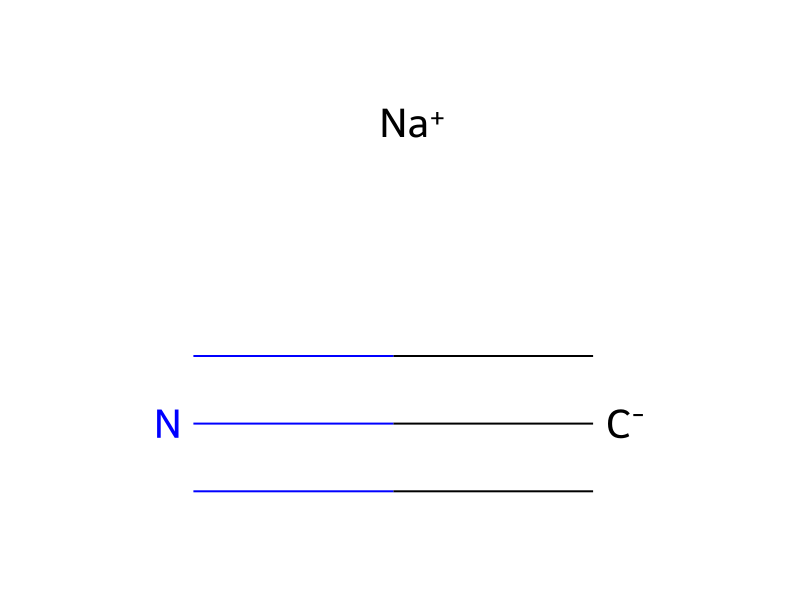



Product 1

Reagents, catalysts & solvents 2


Procedure
Production of 2DG can be carried out using any known method. For example, 2-DG can be prepared from various starting materials such as D-glucose, D-mannose, calcium D-gluconate, D-arabinose, D-glucosamine hydrochloride, N-acetyl glucosamine, chitin, and chitosan and carboxymethylchitosan. Preparation methods vary with various starting materials. For example, D-glucose can be methylated and brominated, followed by debromination and acid hydrolysis to yield β-2DG. Bergmann et. al. (1992) Berichte der Deutschen Chemischen Gesellschaft Jahrg. 55:158-72. D-glucose or D-mannose can be treated with bromine and acetyl, followed by a Fischer procedure (Fischer et al. (1914) (Berichte der Deutschen Chemischen Gesellschaft Jahrg. 47:196-210), to yield 3,4,6-tri-O-acetyl-1,5-anhydro-2-deoxy-D-arabino-hex-1-enitol, which is reacted with bromine, then reduced to remove the acetyl group, yielding 2DG (Arita et al. (1972) Bull. Chem. Soc. Japan 45:567-69). The 3,4,6-tri-O-acetyl-1,5-anhydro-2-deoxy-D-arabino-hex-1-enitol intermediate can be treated with N-bromosuccinimide, followed by hydrogenation and deacetylation to yield 2DG. Monneret and Choay (1981) Carbohydr. Res. 96:299-305. D-glucose can be reacted with ethanethiol and benzoyl chloride, followed by dehydrogenation, reduction, and deprotection to give 2-DG. Wong and Gray (1980) Carbohydr. Res. 80:87-98). Glucal can be deacetylated by reacting with sulfuric acid to give 2-DG with an overall yield of 35%. Overend et al. (1949) J. Chem. Soc., 1:2841-45. D-arabinose can be treated with nitromethane and an acetylating agent, followed by treatment with diluted sodium hydroxide, to yield a-2-DG. Sowden and Fischer (1947)J. Am. Chem. Soc. 69:1048-50. D-arabinose can be condensed, reduced with acetone, then reacted with trifluoromethanesulfonic anhydride, to yield a product that is then reacted with sodium cyanide, followed by hydrogenation, reduction, and hydrolysis, yielding 2-DG. Shiue et al. (1979) Carbohydr. Res. 74:323-26.
Workup
- customto yield a-2-DG
- customcondensed
- customto yield a product that
- customfollowed by hydrogenation, reduction, and hydrolysis
Sources & evidence
- ORD record
- ord-659e6c57ceeb422aac93579b5978f095
- Source dataset
- uspto-grants-2013_05
- Patent number
- US08445021B2
Reaction notes
Loading…