Triphenylphosphine → 4-Bromo-3-(2-m-tolyl-ethoxy)-benzoic acid methyl ester
Reaction equation

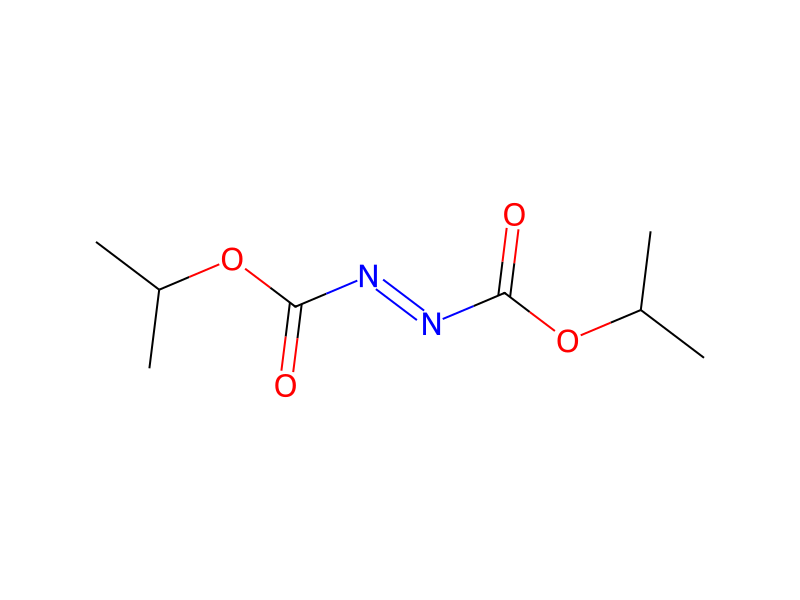
[CH3:1][O:2][C:3](=[O:12])[C:4]1[CH:9]=[CH:8][C:7]([Br:10])=[C:6]([OH:11])[CH:5]=1.C1(P(C2C=CC=CC=2)C2C=CC=CC=2)C=CC=CC=1.[CH3:32][C:33]1[CH:34]=[C:35]([CH2:39][CH2:40]O)[CH:36]=[CH:37][CH:38]=1.CC(OC(/N=N/C(OC(C)C)=O)=O)C>C1COCC1>[CH3:1][O:2][C:3](=[O:12])[C:4]1[CH:9]=[CH:8][C:7]([Br:10])=[C:6]([O:11][CH2:40][CH2:39][C:35]2[CH:34]=[C:33]([CH3:32])[CH:38]=[CH:37][CH:36]=2)[CH:5]=1Participants
6
Reactant 4



Product 1

Reagents, catalysts & solvents 1

Procedure
4-Bromo-3-hydroxy-benzoic acid methyl ester (1.00 g, 4.32 mmol) and triphenylphosphine (1.36 g, 5.19 mmol) were dissolved in THF. 2-(3-Methylphenyl)-ethanol (2-m-tolyl-ethanol) (0.707 g, 5.19 mmol) was added, the mixture was cooled in an ice bath, and DIAD (1.05 g, 5.19 mmol) was added slowly with stirring. The ice bath was removed and stirring continued overnight at room temperature. The volatiles were evaporated in vacuo, and the residue was purified by silica gel chromatography (HEP/EA gradient) to give 1.55 g of the title compound.
Workup
- temperaturethe mixture was cooled in an ice bath
- customThe ice bath was removed
- stirringstirring continued overnight at room temperature
- customThe volatiles were evaporated in vacuo
- customthe residue was purified by silica gel chromatography (HEP/EA gradient)
Sources & evidence
- ORD record
- ord-226ca913f48d4b9b9f7c24cf7d701975
- Source dataset
- uspto-grants-2013_05
- Patent number
- US08445530B2
Reaction notes
Loading…