Pyrazole → HCID 59593158, compound
Reaction equation

Br[CH2:2][C:3]1[S:11][C:10]2[C:9]([N:12]3[CH2:17][CH2:16][O:15][CH2:14][CH2:13]3)=[N:8][C:7](Cl)=[N:6][C:5]=2[CH:4]=1.[NH:19]1[CH:23]=[CH:22][CH:21]=[N:20]1.C([O-])([O-])=O.[K+].[K+]>CN(C=O)C>[N:19]1([CH2:2][C:3]2[S:11][C:10]3[C:9]([N:12]4[CH2:17][CH2:16][O:15][CH2:14][CH2:13]4)=[N:8][C:7]([C:5]4[CH:4]=[CH:3][CH:2]=[C:21]5[C:22]=4[CH:23]=[N:19][NH:20]5)=[N:6][C:5]=3[CH:4]=2)[CH:23]=[CH:22][CH:21]=[N:20]1Participants
5
Reactant 3
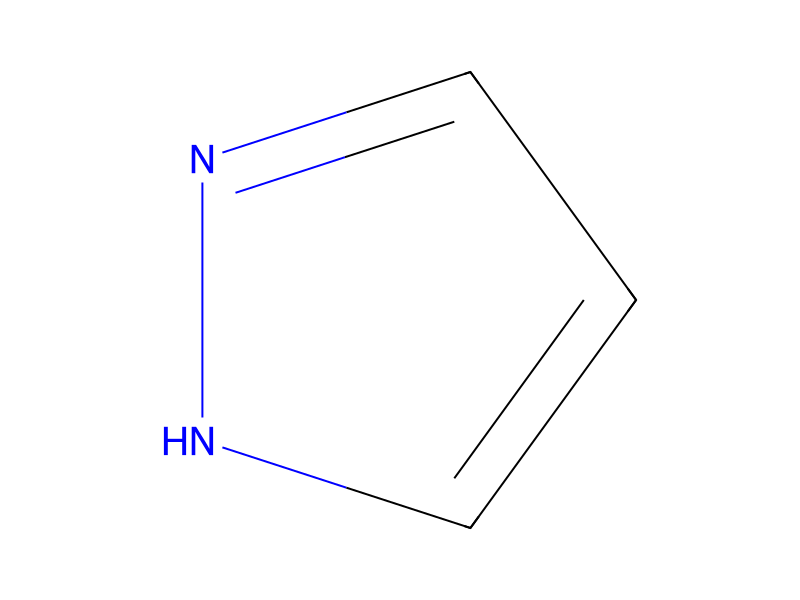


Product 1

Reagents, catalysts & solvents 1

Procedure
To a solution of 6-(bromomethyl)-2-chloro-4-morpholinothieno[3,2-d]pyrimidine 30 from Example 9 (90 mg, 0.3 mmol) in DMF (3 mL) was added pyrazole (18 mg, 0.3 mmol) and K2CO3 (50 mg, 0.4 mmol). The resulting solution stirred at room temperature overnight then was concentrated in vacuo. The residue was diluted with water and filtered. The crude product was utilized in a Suzuki coupling using General Procedure A with 4-(4,4,5,5-tetramethyl-1,3,2-dioxaborolan-2-yl)-1H-indazole 7 to provide 325 after reverse phase HPLC purification (13 mg). MS (Q1) 418 (M)+
Workup
- concentrationthen was concentrated in vacuo
- additionThe residue was diluted with water
- filtrationfiltered
Sources & evidence
- ORD record
- ord-0de84947579e43578c9c664abb58b18d
- Source dataset
- uspto-grants-2013_05
- Patent number
- US08450315B2
Reaction notes
Loading…