Pyrrolidine → 4-(Trifluoromethyl)-1H-indole
Reaction equation

[CH3:1][C:2]1[C:7]([C:8]([F:11])([F:10])[F:9])=[CH:6][CH:5]=[CH:4][C:3]=1[N+:12]([O-])=O.N1CCC[CH2:16]1.COC(OC)N(C)C>CN(C=O)C>[F:9][C:8]([F:11])([F:10])[C:7]1[CH:6]=[CH:5][CH:4]=[C:3]2[C:2]=1[CH:1]=[CH:16][NH:12]2Participants
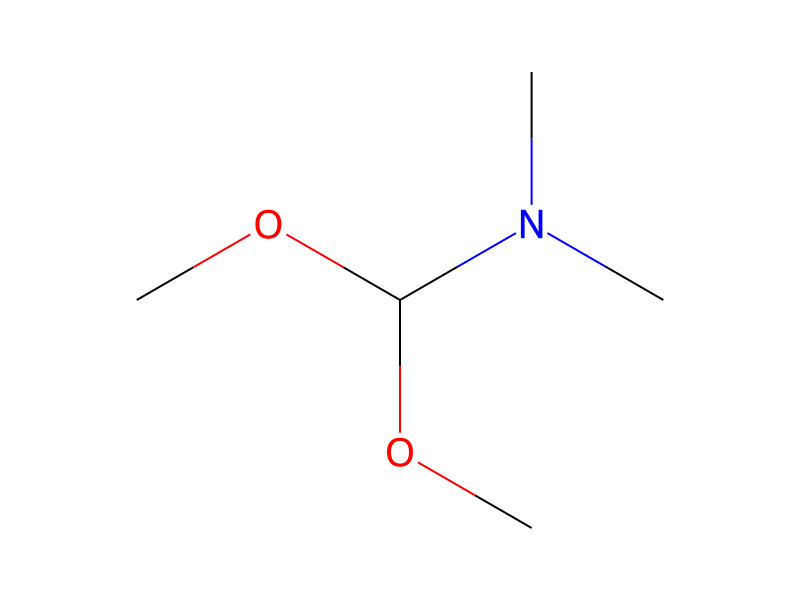
Reactant 3


Product 1

Reagents, catalysts & solvents 1

Conditions
- Temperature
- 60 °C
Procedure
A solution of 2-methyl-1-nitro-3-(trifluoromethyl)benzene (10.00 g, 48.8 mmol), pyrrolidine (4.44 mL, 53.7 mmol) and dimethylformamide dimethylacetal (19.8 mL, 146 mmol) in DMF (100 mL) was heated at 100° C. for 4 h, cooled and concentrated in vacuo. The residue was partitioned between Et2O/H2O, the layers were separated and the aqueous layer was extracted with Et2O (×3). Combined organics were washed (H2O, brine), dried over Na2SO4, filtered and concentrated in vacuo. The residue was dissolved in THF/MeOH (1:1, 200 mL), and transferred to a 3-necked flask equipped with an overhead stirrer, reflux condenser, and dropping addition funnel. Raney-Ni (Raney® 2800 slurry in water, 10 g) was added in one portion and the entire apparatus was thoroughly flushed with N2. The mixture was heated to 60° C., under N2, and a solution of hydrazine monohydrate (8 mL) in THF/MeOH (1:1, 20 mL) was added dropwise over 1 h. The mixture was heated at 60° C. for 1 h, cooled, and filtered through a pad of Celite®. The filtrate was concentrated in vacuo, the residue was partitioned between Et2O/H2O, the layers were separated and the aqueous layer was extracted with Et2O (×3). Combined organics were washed (10% HCl, H2O, brine), dried over Na2SO4, filtered and concentrated in vacuo. The residue was purified by flash chromatography (EtOAc/hexanes), affording 5.17 g of the title compound as a light brown liquid: 1H NMR (300 MHz, methanol-d4) δ 7.61 (d, J=8.2 Hz, 1H), 7.39 (d, J=3.2 Hz, 1H), 7.32 (d, J=7.4 Hz, 1H), 7.19 (partially resolved dd, J 8.4, 7.5 Hz, 1H), 6.59 (br. s, 1H).
Workup
- temperaturecooled
- concentrationconcentrated in vacuo
- customThe residue was partitioned between Et2O/H2O
- customthe layers were separated
- extractionthe aqueous layer was extracted with Et2O (×3)
- washCombined organics were washed (H2O, brine)
- dry with materialdried over Na2SO4
- filtrationfiltered
- concentrationconcentrated in vacuo
- dissolutionThe residue was dissolved in THF/MeOH (1:1, 200 mL)
- customtransferred to a 3-necked flask
- customequipped with an overhead stirrer
- temperaturereflux condenser
- additionaddition funnel
- additionRaney-Ni (Raney® 2800 slurry in water, 10 g) was added in one portion
- customthe entire apparatus was thoroughly flushed with N2
- additiona solution of hydrazine monohydrate (8 mL) in THF/MeOH (1:1, 20 mL) was added dropwise over 1 h
- temperatureThe mixture was heated at 60° C. for 1 h
- temperaturecooled
- filtrationfiltered through a pad of Celite®
- concentrationThe filtrate was concentrated in vacuo
- customthe residue was partitioned between Et2O/H2O
- customthe layers were separated
- extractionthe aqueous layer was extracted with Et2O (×3)
- washCombined organics were washed (10% HCl, H2O, brine)
- dry with materialdried over Na2SO4
- filtrationfiltered
- concentrationconcentrated in vacuo
- customThe residue was purified by flash chromatography (EtOAc/hexanes)
Sources & evidence
- ORD record
- ord-3ebf3dd6c288414699a1fd1dbe54b05c
- Source dataset
- uspto-grants-2009_08
- Patent number
- US07572820B2
Reaction notes
Loading…