2-Bromopyridine → 2-Bromo-6-(pyridin-2-yl)pyridine
Reaction equation

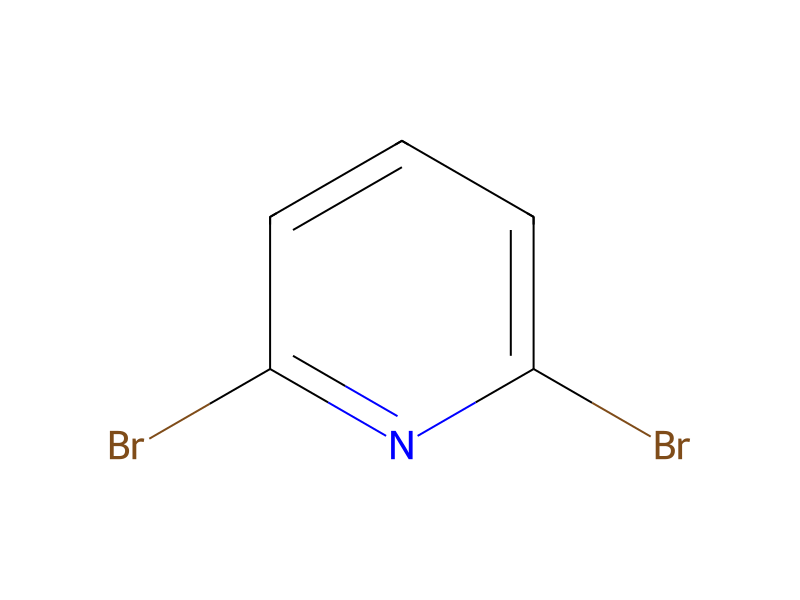
[Br:1][C:2]1[CH:7]=[CH:6][CH:5]=[CH:4][N:3]=1.C([Li])CCC.Br[C:14]1[CH:19]=[CH:18][CH:17]=[C:16](Br)[N:15]=1>[Cl-].[Zn+2].[Cl-].C1C=CC([P]([Pd]([P](C2C=CC=CC=2)(C2C=CC=CC=2)C2C=CC=CC=2)([P](C2C=CC=CC=2)(C2C=CC=CC=2)C2C=CC=CC=2)[P](C2C=CC=CC=2)(C2C=CC=CC=2)C2C=CC=CC=2)(C2C=CC=CC=2)C2C=CC=CC=2)=CC=1.C1COCC1.CCCCCC>[Br:1][C:2]1[N:3]=[C:4]([C:14]2[CH:19]=[CH:18][CH:17]=[CH:16][N:15]=2)[CH:5]=[CH:6][CH:7]=1Participants
Reactant 3


Product 1

Reagents, catalysts & solvents 4




Conditions
- Temperature
- 0 °C
Procedure
In a nitrogen atmosphere, a THF (5 ml) solution of bromopyridine (0.5 g) was cooled to −78° C., then a hexane solution of n-butyllithium (1.57 M, 2 ml) was added dropwise thereto, after dropwise, the mixture was stirred at 0° C. for 3 hours. Thereafter, a THF solution of zinc chloride (3.15 g) was added dropwise to the mixture, after dropwise, the mixture was stirred for 3 hours. Next, 2,6-dibromopyridine (0.75 g) and tetrakis(triphenylphosphine)palladium (146 mg) were added to the mixture at room temperature, and the mixture was refluxed for 1 day. After the reaction mixture was allowed to cool, to which was then added water, the mixture was extracted with toluene, the solvent was distilled off, and the residue was purified by silica gel column chromatography, thereby obtaining desired compound as white crystal (0.5 g).
Workup
- stirringafter dropwise, the mixture was stirred for 3 hours
- temperaturethe mixture was refluxed for 1 day
- temperatureto cool, to which
- extractionadded water, the mixture was extracted with toluene
- distillationthe solvent was distilled off
- customthe residue was purified by silica gel column chromatography
Sources & evidence
- ORD record
- ord-2735ac6a69a14e95bf4c5163b9fd3526
- Source dataset
- uspto-grants-2008_10
- Patent number
- US07442797B2
Reaction notes
Loading…