Triphenylphosphine → Triphenylphosphine Oxide
Reaction equation

C[O:2]C(OC)C1C=CC=CC=1O.[C:13]1([P:19]([C:26]2[CH:31]=[CH:30][CH:29]=[CH:28][CH:27]=2)[C:20]2[CH:25]=[CH:24][CH:23]=[CH:22][CH:21]=2)[CH:18]=[CH:17][CH:16]=[CH:15][CH:14]=1.CCOC(/N=N/C(OCC)=O)=O>O1CCCC1>[C:26]1([P:19](=[O:2])([C:13]2[CH:14]=[CH:15][CH:16]=[CH:17][CH:18]=2)[C:20]2[CH:25]=[CH:24][CH:23]=[CH:22][CH:21]=2)[CH:27]=[CH:28][CH:29]=[CH:30][CH:31]=1Participants
Reactant 3



Product 1
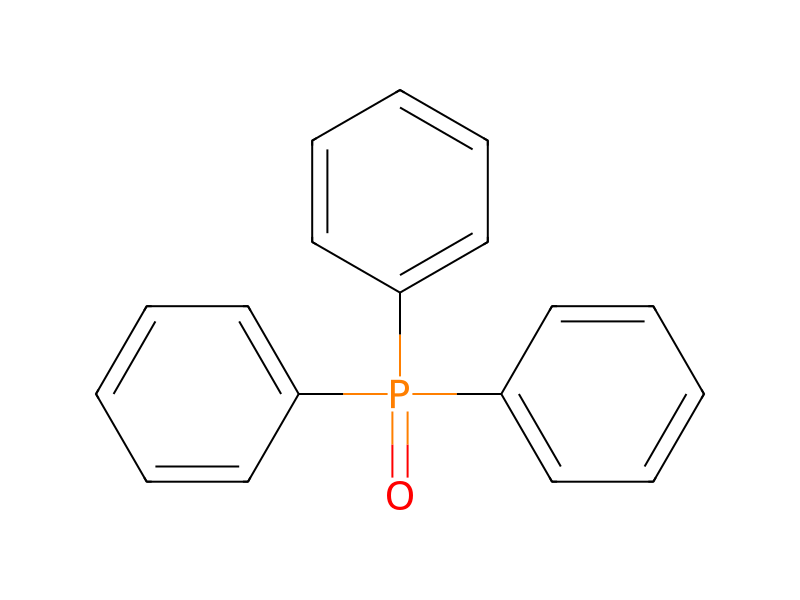
Reagents, catalysts & solvents 1

Procedure
To a mixture of 4.2 g. of [1(S),4R]-1-[3-(benzoylthio)-2-methyl-1-oxopropyl]-4-hydroxy-L-proline, methyl ester, 3 g. of 2-(dimethoxymethyl)-phenol, 4.6 g. of triphenylphosphine dissolved in 15 ml. of tetrahydrofuran there is added 3.1 g. of diethylazodicarboxylate dissolved in 5 ml. of tetrahydrofuran (nitrogen atmosphere). The mixture becomes warm. The solution is stirred overnight. Addition of ether/petroleum ether yields 1.1 g. of dicarbethoxyhydrazine which is filtered off. Addition of more petroleum ether to the filtrate furnishes oily triphenylphosphine oxide which on trituration with ether turns solid; 2.5 g. The filtrate is absorbed on Baker silica and flash chromatographed. Elution with 85% ether - 10% petroleum ether elutes the pure product in six fractions, 250 ml. each, yielding 2.99 g. of [1(S),4S]-1-[3-(benzoylthio)-2methyl-1-oxopropyl]-4-[2-(dimethoxymethyl)phenoxy]-L-proline, methyl ester. A small sample is characterized and analyzed as its 2,4-dinitrophenyl hydrazine derivative.
Workup
- additionTo a mixture of 4.2 g
- temperatureThe mixture becomes warm
- customyields 1.1 g
- filtrationof dicarbethoxyhydrazine which is filtered off
- additionAddition of more petroleum ether to the filtrate
Sources & evidence
- ORD record
- ord-355af4c0577c4caf8c95ce5bc38df970
- Source dataset
- uspto-grants-1987_07
- Patent number
- US04681886
Reaction notes
Loading…