Methyl Isobutyl Ketone → p-1-Ethoxyethoxystyrene p-hydroxystyrene
Reaction equation

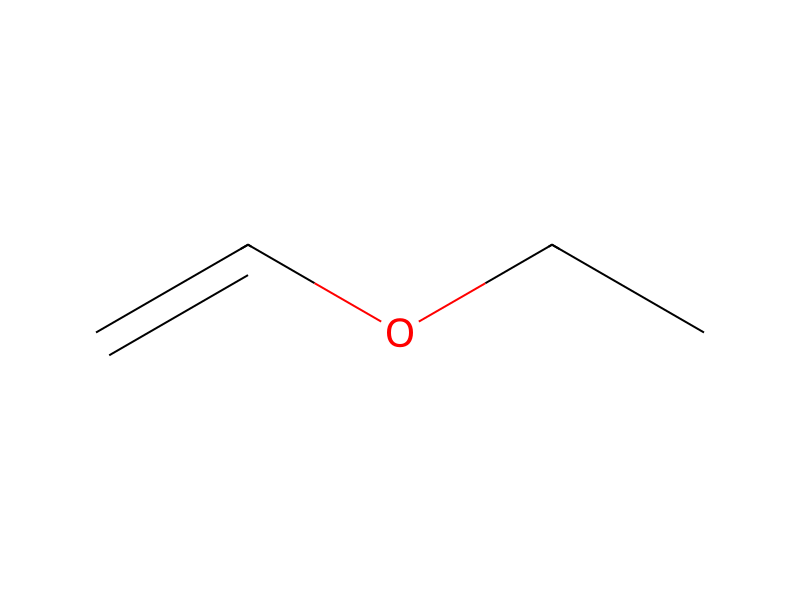
[CH:1]#[C:2][C:3]1[CH:8]=[CH:7][C:6]([OH:9])=[CH:5][CH:4]=1.O.C1(C)C=CC(S(O)(=O)=O)=CC=1.C(C(C)=O)C(C)C.[CH:29]([O:31][CH2:32][CH3:33])=[CH2:30]>O>[CH2:29]([O:31][CH2:32][CH2:33][O:9][C:6]1[CH:7]=[CH:8][C:3]([CH:2]=[CH2:1])=[CH:4][CH:5]=1)[CH3:30].[OH:9][C:6]1[CH:7]=[CH:8][C:3]([CH:2]=[CH2:1])=[CH:4][CH:5]=1Participants




Conditions
- Temperature
- 25 °C
Procedure
Into a flask were charged 108.3 g of a solution of poly(p-hydroxystyrene)(weight-average molecular weight: about 15200, degree of dispersion: 1.20 (GPC method: reduced by polystyrene), 30.0 g as the weight of poly(p-hydroxystyrene)), 0.005 g of p-toluenesulfonic acid monohydrate and 102 g of methyl isobutyl ketone, and the mixture was stirred. Into this resin solution was dropped 8.7 g of ethyl vinyl ether (0.12 mol, 0.48 equivalent based on hydroxyl groups in poly(p-hydroxystyrene)) using a dropping funnel. The mixture was stirred at 25° C. for 3 hours, then, to this was added 15 g of methyl isobutylketone and 57 g of ion exchanged water, and the solution was separated. Further, the resulted organic layer was washed with 57 g of ion exchanged water and separated, four times.
Workup
- customthe solution was separated
- washFurther, the resulted organic layer was washed with 57 g of ion
- customseparated
Sources & evidence
- ORD record
- ord-95972876bd2d4b5392884bee5e15eb8a
- Source dataset
- uspto-grants-2004_02
- Patent number
- US06689531B2
Reaction notes
Loading…