Trifluoroacetic acid → 4-Bromo-1,2-dihydro-pyrrolo[3,4-c]pyridin-3-one
Reaction equation

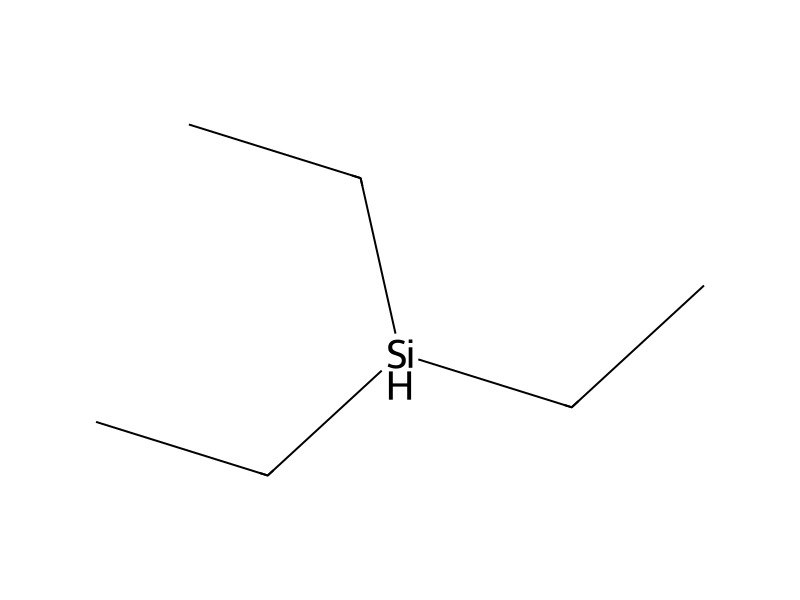
[Br:1][C:2]1[C:7]2[C:8](=[O:21])[N:9](C(C)(C3C=CC=CC=3)C)[CH:10](O)[C:6]=2[CH:5]=[CH:4][N:3]=1.FC(F)(F)C(O)=O.C([SiH](CC)CC)C>[N+](C)([O-])=O>[Br:1][C:2]1[C:7]2[C:8](=[O:21])[NH:9][CH2:10][C:6]=2[CH:5]=[CH:4][N:3]=1Participants
5
Reactant 3


Product 1

Reagents, catalysts & solvents 1

Procedure
In a similar manner to Step 4 of Example 16, 4-bromo-1-hydroxy-2-(1-methyl-1-phenylethyl)-1,2-dihydropyrrolo[3,4-c]pyridine-3-one (239 mg, 0.688 mmol) was dissolved in nitromethane (12 mL), and the solution was treated with trifluoroacetic acid (1.17 mL, 15.1 mmol) and triethylsilane (0.440 mL, 2.75 mmol), followed by purification by preparative thin-layer chromatography (chloroform/methanol=15/1) to obtain 4-bromo-1,2-dihydropyrrolo[3,4-c]pyridine-3-one (49.1 mg, yield 34%).
Workup
- customfollowed by purification by preparative thin-layer chromatography (chloroform/methanol=15/1)
Sources & evidence
- ORD record
- ord-1c154c18124c483081af4cb314070f73
- Source dataset
- uspto-grants-2010_06
- Patent number
- US07745641B2
Reaction notes
Loading…