Hydrochloric Acid → HCID 20403330, compound
Reaction equation
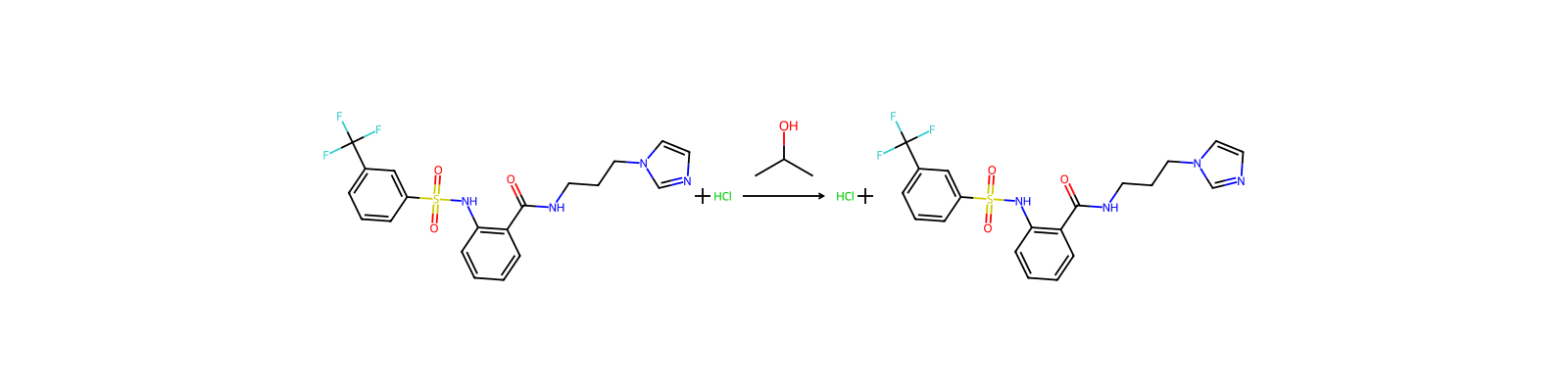
[F:1][C:2]([F:31])([F:30])[C:3]1[CH:4]=[C:5]([S:9]([NH:12][C:13]2[CH:29]=[CH:28][CH:27]=[CH:26][C:14]=2[C:15]([NH:17][CH2:18][CH2:19][CH2:20][N:21]2[CH:25]=[CH:24][N:23]=[CH:22]2)=[O:16])(=[O:11])=[O:10])[CH:6]=[CH:7][CH:8]=1.[ClH:32]>C(O)(C)C>[ClH:32].[F:30][C:2]([F:1])([F:31])[C:3]1[CH:4]=[C:5]([S:9]([NH:12][C:13]2[CH:29]=[CH:28][CH:27]=[CH:26][C:14]=2[C:15]([NH:17][CH2:18][CH2:19][CH2:20][N:21]2[CH:25]=[CH:24][N:23]=[CH:22]2)=[O:16])(=[O:11])=[O:10])[CH:6]=[CH:7][CH:8]=1Participants
4
Reactant 2


Product 1

Reagents, catalysts & solvents 1

Procedure
2-(3-Trifluoromethylbenzenesulphonamido)-N-(3-imidazol-1-ylpropyl)benzamide (9.0 g) was dissolved in hot isopropanol (90 ml). Concentrated aqueous hydrochloric acid (2.0 ml) was added. The resultant solution was evaporated to yield an oil which was recrystallised from ethyl acetate to give 2-(3-trifluoromethylbenzenesulphonamido)-N-(3-imidazol-1-ylpropyl)benzamide hydrochloride (9.3 g) in the form of a white solid, m.p. 173°-175° C.
Workup
- customThe resultant solution was evaporated
- customto yield an oil which
- customwas recrystallised from ethyl acetate
Sources & evidence
- ORD record
- ord-7fc0e9fa652c4da6a26cdc2fb96a2743
- Source dataset
- uspto-grants-1985_03
- Patent number
- US04507315
Reaction notes
Loading…