Hydrochloric Acid → (S)-1-[(S)-2-(2-cyclopropyl-2-hydroxy-acetylamino)-propionyl]-hexahydro-pyridazine-3-carboxylic acid [(R)-1-(7-bromo-quinolin-2-yl)-ethyl]-amide
Reaction equation

C([O:5][C:6](=O)[NH:7][C@@H:8]([CH3:33])[C:9]([N:11]1[CH2:16][CH2:15][CH2:14][C@@H:13]([C:17](=[O:32])[NH:18][C@@H:19]([C:21]2[CH:30]=[CH:29][C:28]3[C:23](=[CH:24][C:25]([Br:31])=[CH:26][CH:27]=3)[N:22]=2)[CH3:20])[NH:12]1)=[O:10])(C)(C)C.Cl.[CH:36]1([CH:39]([OH:43])C(O)=O)[CH2:38][CH2:37]1.C(N(CC)C(C)C)(C)C.F[P-](F)(F)(F)(F)F.N1(O[P+](N(C)C)(N(C)C)N(C)C)C2C=CC=CC=2N=N1>ClCCl.O1CCOCC1>[Br:31][C:25]1[CH:24]=[C:23]2[C:28]([CH:29]=[CH:30][C:21]([C@H:19]([NH:18][C:17]([C@@H:13]3[CH2:14][CH2:15][CH2:16][N:11]([C:9](=[O:10])[C@@H:8]([NH:7][C:6](=[O:5])[CH:39]([CH:36]4[CH2:38][CH2:37]4)[OH:43])[CH3:33])[NH:12]3)=[O:32])[CH3:20])=[N:22]2)=[CH:27][CH:26]=1Participants
Reactant 5
 HCID 313Hydrochloric Acid2×
 HCID 81531Diisopropylethylamine
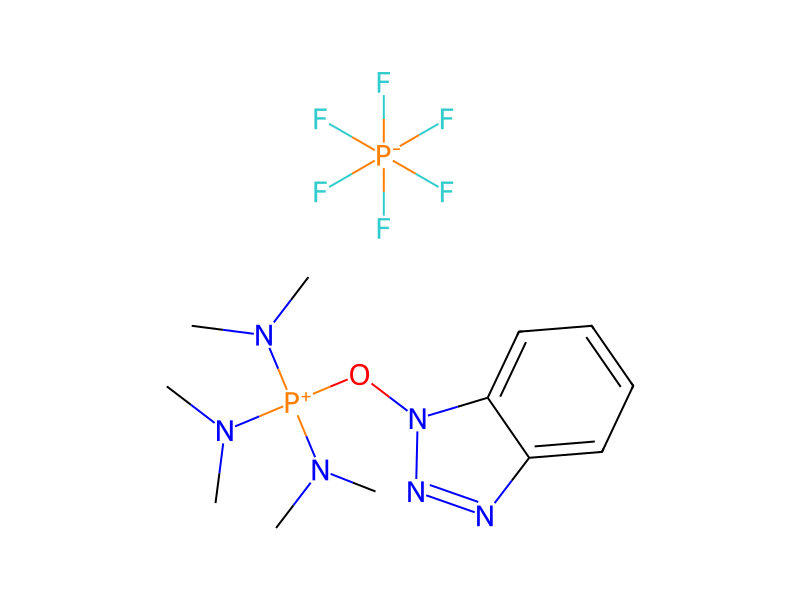 HCID 151348Benzotriazol-1-yloxy-tris(dimethylamino)phosphonium hexafluorophosphate
 HCID 13030266alpha-Hydroxycyclopropaneacetic acid
 HCID 86706107((S)-2-{(S)-3-[(R)-1-(7-bromo-quinolin-2-yl)-ethylcarbamoyl]-tetrahydro-pyridazin-1-yl}-1-methyl-2-oxo-ethyl)-carbamic acid tert-butyl ester
Product 1

Reagents, catalysts & solvents 2


Conditions
- Temperature
- 0 °C
Procedure
((S)-2-{(S)-3-[(R)-1-(7-Bromo-quinolin-2-yl)-ethylcarbamoyl]-tetrahydro-pyridazin-1-yl}-1-methyl-2-oxo-ethyl)-carbamic acid tert-butyl ester, (1.07 g, 2.00 mmol) was suspended in dichloromethane (20 mL) and the mixture was cooled to 0° C. with stirring. 4 M Hydrogen chloride in 1,4-dioxane (11 mL) was added and the reaction mixture stirred for 90 minutes and then evaporated. Residual water was azeotroped off with toluene and the residue was suspended in dichloromethane (20 mL) and cyclopropyl-hydroxy-acetic acid (255 mg, 2.20 mmol) was added. The mixture was cooled to 0° C. with stirring and N,N-diisopropylethylamine (775 mg, 1.05 mL, 6.00 mmol) was added followed by (benzotriazol-1-yloxy)tris(dimethylamino)phosphonium hexafluorophosphate (1.06 g, 2.40 mmol). The reaction was allowed to warm to ambient temperature and stirred for 18 h. 1M Hydrochloric acid was added and the organic layer was washed with saturated sodium bicarbonate solution, passed through a hydrophobic frit and evaporated. The residue was purified by silica gel chromatography eluting with a gradient of ethyl acetate/methanol 1:0 to 9:1 to afford the title compound (328 mg) as a white foam. The original aqueous extracts were re-extracted with dichloromethane/methanol (9:1, 2×) and the organic extracts dried over anhydrous sodium sulfate, filtered and evaporated. The residue purified by silica gel chromatography eluting with a gradient of ethyl acetate/methanol 1:0 to 17:3 to afford the title compound (378 mg) as a white foam. The two foams were combined (706 mg, 66%). 1H NMR (300 MHz, CDCl3) δ 0.46-0.73 (m, 4H), 1.04-1.18 (m, 1H), 1.49-1.59 (m, 6H), 1.53-1.78 (m, 2H), 1.95-2.04 (m, 1H), 2.25-2.34 (m, 1H), 2.64-2.82 (m, 1H), 3.44-3.55 (m, 2H), 3.60-3.84 (m, 1H), 4.50-4.60 (m, 1H), 5.23-5.33 (m, 1H), 5.48-5.55 (m, 1H), 7.36-7.41 (m, 1H), 7.62-7.73 (m, 2H), 8.13-8.19 (m, 2H), 8.47-8.51 (m, 1H). LCMS (m/z) [M+H] 532.0, 534.0 Tr=2.07 min. LCMS (m/z) 532.0, 533.9 [M+H], Tr=2.12 min.
Workup
- stirringthe reaction mixture stirred for 90 minutes
- customevaporated
- customResidual water was azeotroped off with toluene
- temperatureThe mixture was cooled to 0° C.
- stirringwith stirring
- temperatureto warm to ambient temperature
- stirringstirred for 18 h
- washthe organic layer was washed with saturated sodium bicarbonate solution
- customevaporated
- customThe residue was purified by silica gel chromatography
- washeluting with a gradient of ethyl acetate/methanol 1:0 to 9:1
Sources & evidence
- ORD record
- ord-48577d65b83e4a7c8ef16f6bd4bb24b2
- Source dataset
- uspto-grants-2015_06
- Patent number
- US09062092B2
Reaction notes
Loading…