4-Bromoanisole → Tris(4-methoxyphenyl)phosphine oxide
Reaction equation

[Mg].Br[C:3]1[CH:8]=[CH:7][C:6]([O:9][CH3:10])=[CH:5][CH:4]=1.[O:11]=[P:12](Cl)(Cl)Cl>BrCCBr.C1COCC1>[CH3:10][O:9][C:6]1[CH:7]=[CH:8][C:3]([P:12](=[O:11])([C:3]2[CH:8]=[CH:7][C:6]([O:9][CH3:10])=[CH:5][CH:4]=2)[C:3]2[CH:8]=[CH:7][C:6]([O:9][CH3:10])=[CH:5][CH:4]=2)=[CH:4][CH:5]=1Participants
6
Reactant 3
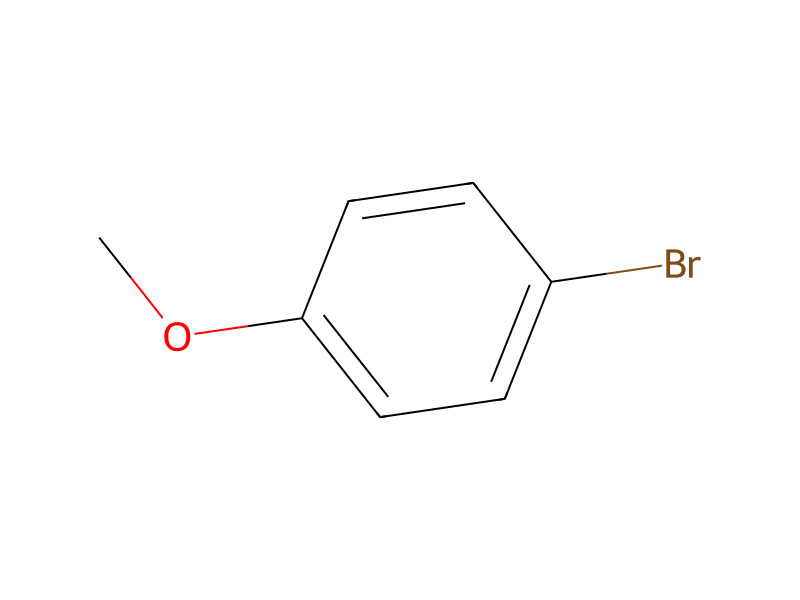


Product 1

Reagents, catalysts & solvents 2


Procedure
A reaction flask under nitrogen containing magnesium turnings (223.9 g, 9.21 mol) and 1950 mL THF was charged with 1 drop of 1,2-dibromoethane and heated to reflux for 1 h. Heating was removed and p-bromoanisole (1683 g, 9.00 mol) was added dropwise at a rate to maintain reflux. After holding the reaction mixture overnight, POCl3 (460.0 g, 3.00 mol) was added slowly over 2 h at 50-79° C. and the resulting mixture was held overnight at 50° C. The product was isolated by aqueous workup to give 984.5 g of tris(4-methoxyphenyl)phosphine oxide (89.0% yield). Recrystallized analytical specimen (from ethyl acetate): mp 145.2° C. (DSC), lit. 143-144° C. (J. Org. Chem. 1960, 25, 2001).
Workup
- temperatureheated
- temperatureto reflux for 1 h
- temperatureHeating
- customwas removed
- temperatureto maintain
- temperaturereflux
- additionwas added slowly over 2 h at 50-79° C.
- customThe product was isolated by aqueous workup
Sources & evidence
- ORD record
- ord-5ffe18a3640b4965bc7f2f7132cd1bff
- Source dataset
- uspto-grants-2005_05
- Patent number
- US06887950B2
Reaction notes
Loading…