Ethylene Glycol → 2-(4-Tert-butylphenyl)sulfanylaniline
Reaction equation

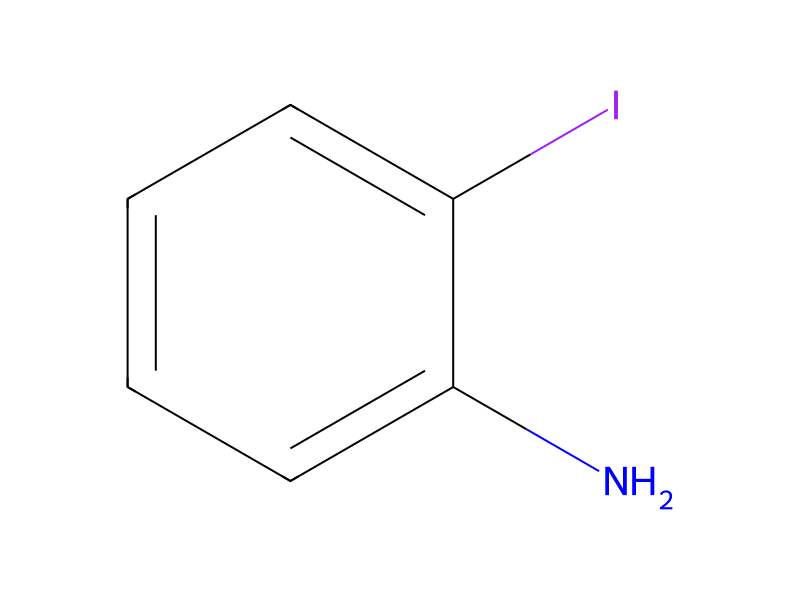
I[C:2]1[CH:8]=[CH:7][CH:6]=[CH:5][C:3]=1[NH2:4].[C:9]([C:13]1[CH:18]=[CH:17][C:16]([SH:19])=[CH:15][CH:14]=1)([CH3:12])([CH3:11])[CH3:10].C([O-])([O-])=O.[K+].[K+].C(O)CO>[Cu]I.CC(O)C>[C:9]([C:13]1[CH:14]=[CH:15][C:16]([S:19][C:2]2[CH:8]=[CH:7][CH:6]=[CH:5][C:3]=2[NH2:4])=[CH:17][CH:18]=1)([CH3:12])([CH3:10])[CH3:11]Participants
Reactant 4



Product 1

Reagents, catalysts & solvents 2


Procedure
The general procedure in example 39 was followed. 2-Iodoaniline (219 mg, 1.0 mmol), 4-tert-butylthiophenol (166 mg, 1.0 mmol), CuI (10 mg, 0.05 mmol), K2CO3 (276 mg, 2.0 mmol), ethylene glycol (111 μL, 2.0 mmol) and 2-propanol (1.0 mL) were used to obtain the 2-(4-tert-butylphenyl)sulfanylaniline (231 mg, 90% yield) as light yellow liquid. Column chromatographic solvent (hexane/ethyl acetate=20/1). Rf=0.4 (hexane/ethyl acetate=10/1). 1H NMR (CDCl3, 300 MHz) δ 7.42 (dd, 1 H, J=1.5 Hz, 7.5 Hz), 7.17-7.24 (m, 4 H), 7.00 (dt, 2 H, J=1.8 Hz, 8.4 Hz), 6.70-6.78 (m, 2 H), 4.28 (brs, 2 H), 1.26 (s, 9 H). 13C NMR (CDCl3, 75 MHz) δ 148.8, 148.7, 137.5, 133.3, 131.1, 126.5, 126.3, 118.9, 115.5, 115.0, 34.8, 31.7. IR (neat, cm−1) 3471, 3375, 3072, 3062, 3020, 2962, 2902, 2867. MS (EI) m/z (relative intensity) 257 (70), 242 (100). Anal. Cald. for C16H19NS, Cald. C, 74.66; H, 7.44. Found C, 74.64; H, 7.30.
Sources & evidence
- ORD record
- ord-897b71e6ab2c4ff7b86a5fb86f1278cc
- Source dataset
- uspto-grants-2005_05
- Patent number
- US06888032B2
Reaction notes
Loading…