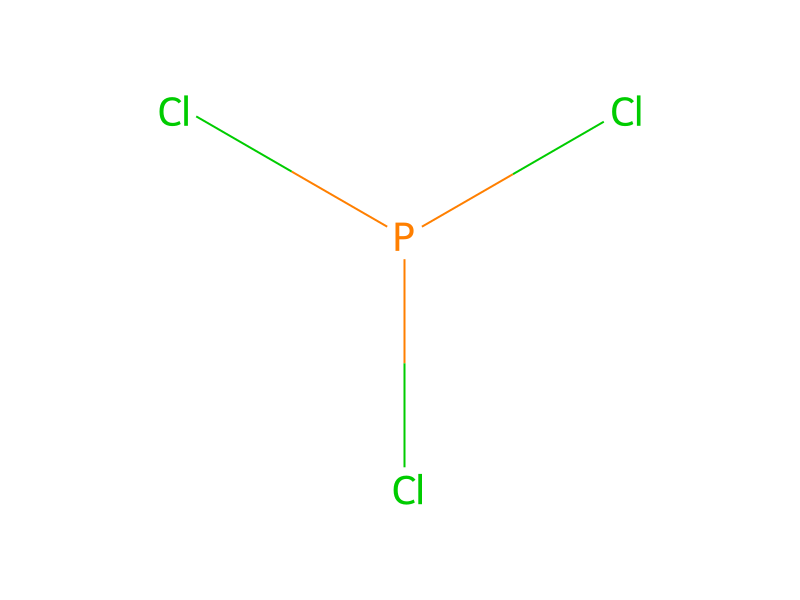
Phosphorus trichloride → HCID 11161344, compound
Reaction equation

[C:1]1([CH3:15])[CH:6]=[CH:5][C:4]([O:7][C:8]2[CH:13]=[CH:12][C:11]([CH3:14])=[CH:10][CH:9]=2)=[CH:3][CH:2]=1.[P:16](Cl)(Cl)[Cl:17].[Cl-].[Cl-].[Cl-].[Al+3].CC1C=CC2OC3C(=CC(C)=CC=3)PC=2C=1C(O)=O.P(Cl)(Cl)(Cl)=O>>[Cl:17][P:16]1[C:5]2[CH:6]=[C:1]([CH3:15])[CH:2]=[CH:3][C:4]=2[O:7][C:8]2[C:13]1=[CH:12][C:11]([CH3:14])=[CH:10][CH:9]=2Participants





Procedure
From the literature, processes are already known for the production of 10-chloro-phenoxaphosphines. Freedman et al describes in J. Organ. Chem. 1961, Vol 26, 284 the conversion of p-tolyl ether with phosphorus trichloride and aluminum trichloride. After the aqueous processing, the reaction product was identified as 2,8-dimethyl-phenoxaphosphinic acid. The 2,8-dimethyl-phenoxaphosphinc acid can be converted analogously to the teaching of Hellwinkel and Krapp in Chem. Ber. 1978, Vol 111, 13 for dibenzophosphoric acid by reaction with phosphorus oxychloride at 200° C. and subsequent reaction with red phosphorus at 180° C. to form 10-chloro-2,8-dimethylphenoxaphosphine. The synthesis from ether is thus a three-stage synthesis and the total yield is 59.6% over all stages. Thus, an economical production of the compound is not possible.
Sources & evidence
- ORD record
- ord-baf74b5e942d43c7ba379bf386b308b8
- Source dataset
- uspto-grants-2002_06
- Patent number
- US06407290B2
Reaction notes
Loading…