1,4-Dioxane → HCID 59166315, compound
Reaction equation

[CH:1]1(P(C2CCCCC2)C2CCCCC2)[CH2:6]CCC[CH2:2]1.[C:20]([O-:23])(=O)[CH3:21].[K+].[O:25]1CCO[BH:26]1.Br[C:31]1[CH:36]=[CH:35][C:34]([C:37]([OH:46])([C:42]([F:45])([F:44])[F:43])[C:38]([F:41])([F:40])[F:39])=[CH:33][CH:32]=1.O1CCOC[CH2:48]1>C1C=CC(/C=C/C(/C=C/C2C=CC=CC=2)=O)=CC=1.C1C=CC(/C=C/C(/C=C/C2C=CC=CC=2)=O)=CC=1.[Pd]>[F:39][C:38]([F:41])([F:40])[C:37]([C:34]1[CH:35]=[CH:36][C:31]([B:26]2[O:25][C:1]([CH3:6])([CH3:2])[C:20]([CH3:21])([CH3:48])[O:23]2)=[CH:32][CH:33]=1)([OH:46])[C:42]([F:45])([F:44])[F:43]Participants
Reactant 5




Product 1
Reagents, catalysts & solvents 1
Conditions
- Temperature
- 80 °C
Procedure
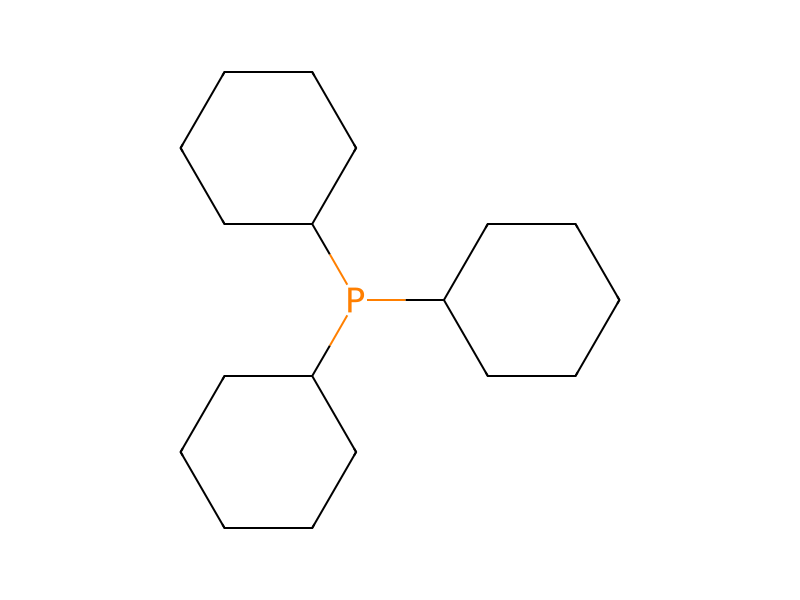
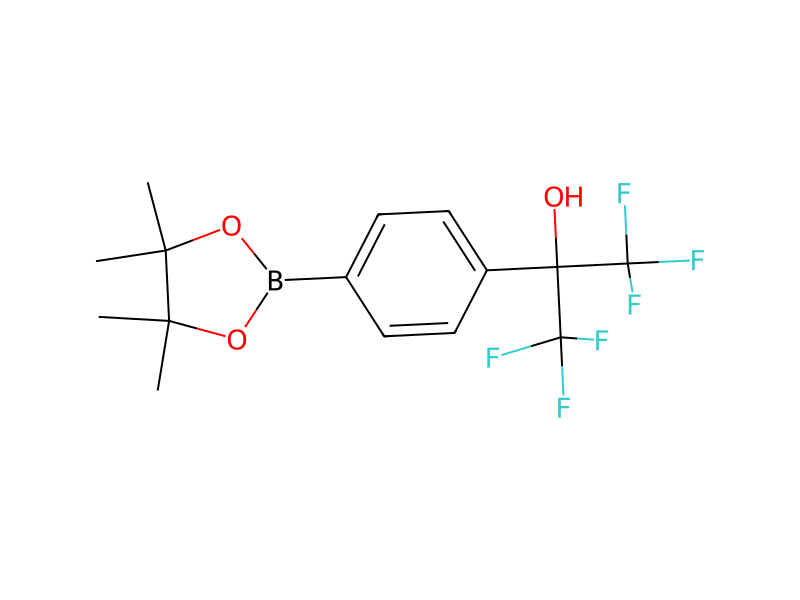
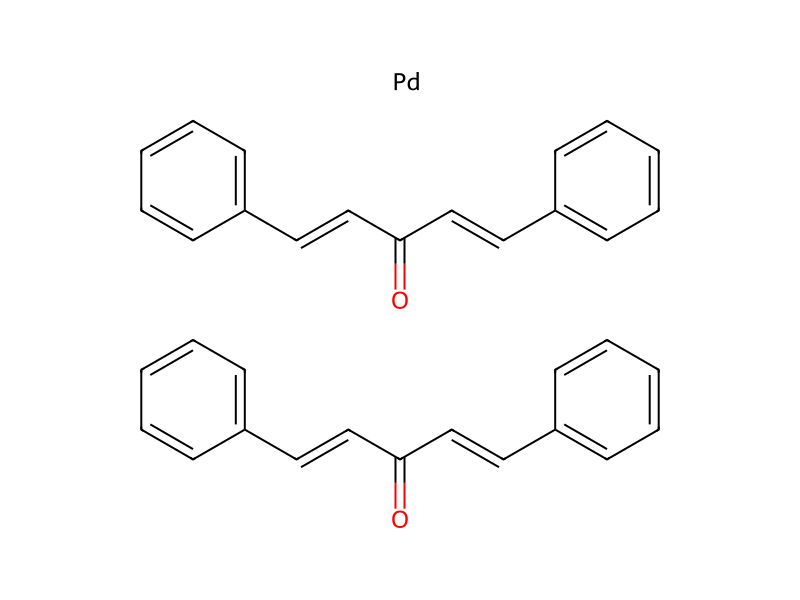
To a suspension of Pd(dba)2 (100 mg, 0.20 mmol) and PCy3 (130 mg, 0.50 mmol) in dioxane (8 mL) were added potassium acetate (920 mg, 9.4 mmol), 4,4,4′,4′,5,5,5′,5′-octamethyl-2,2′-bi(1,3,2-dioxaborolane (1.8 g, 7.1 mmol) and 2-(4-bromophenyl)-1,1,1,3,3,3-hexafluoropropan-2-ol (2.0 g, 6.2 mmol). The mixture was heated at 80° C. overnight. The mixture was quenched with H2O and the aqueous layer was extracted with ethyl acetate. The combined organic layers were washed with brine, dried over MgSO4, and concentrated under reduced pressure. The residue was purified by column chromatography (0-5% ethyl acetate-petroleum ether) to afford 1,1,1,3,3,3-hexafluoro-2-(4-(4,4,5,5-tetramethyl-1,3,2-dioxaborolan-2-yl)phenyl)propan-2-ol (870 mg, 38%). 1H NMR (CDCl3, 400 MHz) δ 7.89 (d, J=8.0 Hz, 2H), 7.71 (d, J=8.0 Hz, 2H), 3.50 (s, 1H), 1.35 (s, 12H).
Workup
- customThe mixture was quenched with H2O
- extractionthe aqueous layer was extracted with ethyl acetate
- washThe combined organic layers were washed with brine
- dry with materialdried over MgSO4
- concentrationconcentrated under reduced pressure
- customThe residue was purified by column chromatography (0-5% ethyl acetate-petroleum ether)
Sources & evidence
- ORD record
- ord-6deb75d61594470c96b8603397fe52aa
- Source dataset
- uspto-grants-2012_12
- Patent number
- US08324207B2
Reaction notes
Loading…