Potassium Carbonate → 4-Bromo-1-(4-fluorophenyl)-1H-pyrazolo[3,4-c]pyridine
Reaction equation

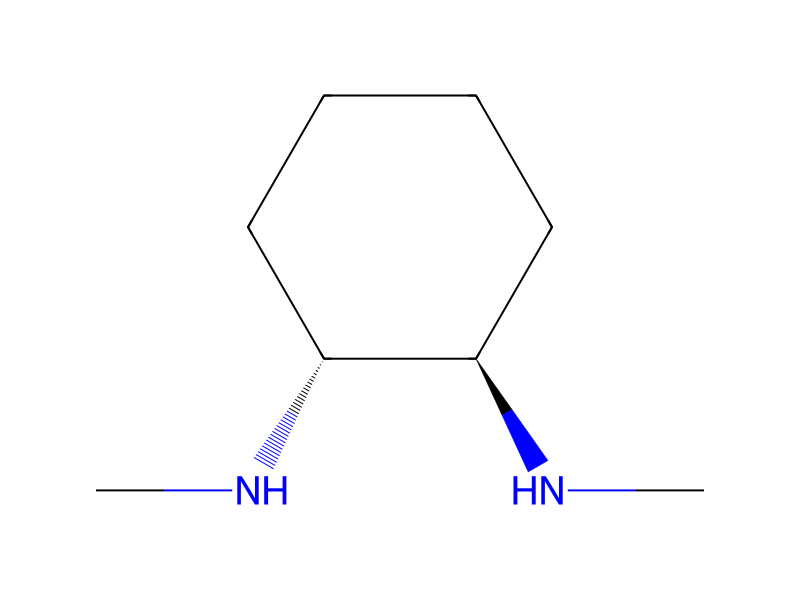
[Br:1][C:2]1[CH:3]=[N:4][CH:5]=[C:6](Br)[C:7]=1/[CH:8]=[N:9]/[NH:10][C:11]1[CH:16]=[CH:15][C:14]([F:17])=[CH:13][CH:12]=1.CN[C@@H]1CCCC[C@H]1NC.C([O-])([O-])=O.[K+].[K+]>CN1C(=O)CCC1.[Cl-].[NH4+].[Cu]I>[Br:1][C:2]1[CH:3]=[N:4][CH:5]=[C:6]2[N:10]([C:11]3[CH:16]=[CH:15][C:14]([F:17])=[CH:13][CH:12]=3)[N:9]=[CH:8][C:7]=12Participants
Reactant 3


Product 1

Reagents, catalysts & solvents 3



Conditions
- Temperature
- 120 °C
Procedure
A mixture of N-[1-(3,5-dibromopyridin-4-yl)-meth-(E)-ylidene]-N′-(4-fluorophenyl)-hydrazine (2.0 g, 5.4 mmol), CuI (50.0 mg, 0.260 mmol), trans-N,N′-dimethylcyclohexane-1,2-diamine (0.200 mL, 1.27 mmol), and K2CO3 (1.4 g, 0.010 mol) in NMP (10 mL) was warmed at 120° C. for 30 minutes. The reaction was monitored by HPLC-MS indicating the desired mass. The mixture was diluted with aqueous ammonium chloride (100 mL) and the resulting solid collected by filtration. The solid was dissolved in hot ethyl acetate (EtOAc), dried over magnesium sulfate, treated with activated carbon, filtered through diatomaceous earth and concentrated. The residue was passed through a pad of silica gel eluting with dichloromethane to afford 4-bromo-1-(4-fluorophenyl)-1H-pyrazolo[3,4-c]pyridine.
Workup
- filtrationthe resulting solid collected by filtration
- dissolutionThe solid was dissolved in hot ethyl acetate (EtOAc)
- dry with materialdried over magnesium sulfate
- additiontreated with activated carbon
- filtrationfiltered through diatomaceous earth
- concentrationconcentrated
Sources & evidence
- ORD record
- ord-eb0a7ed217494c72a88d0b2cb0160b49
- Source dataset
- uspto-grants-2012_12
- Patent number
- US08338610B2
Reaction notes
Loading…