Triphenylphosphine → 3-Cyclopropyl-4-fluoroaniline
Reaction equation

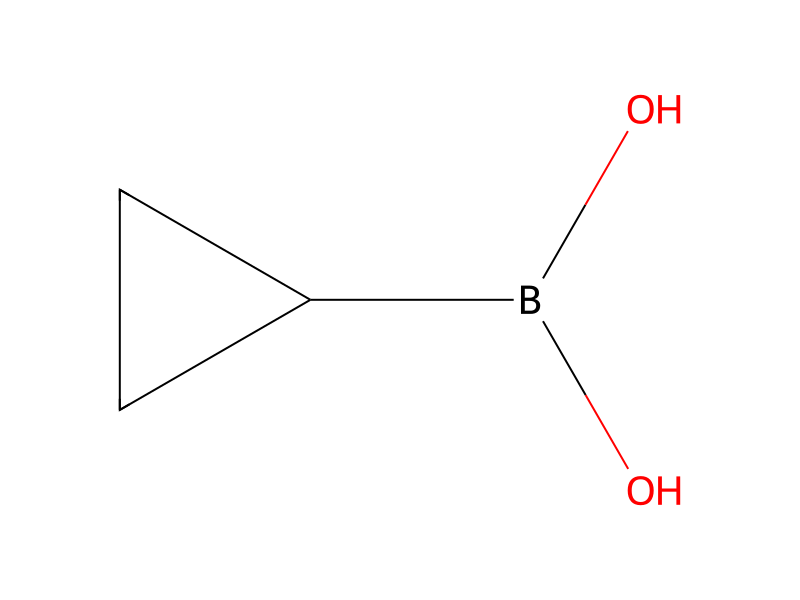
Br[C:2]1[CH:3]=[C:4]([CH:6]=[CH:7][C:8]=1[F:9])[NH2:5].[CH:10]1(B(O)O)[CH2:12][CH2:11]1.[O-]P([O-])([O-])=O.[K+].[K+].[K+].C1(P(C2C=CC=CC=2)C2C=CC=CC=2)C=CC=CC=1>CC([O-])=O.CC([O-])=O.[Pd+2].O.C1(C)C=CC=CC=1>[CH:10]1([C:2]2[CH:3]=[C:4]([CH:6]=[CH:7][C:8]=2[F:9])[NH2:5])[CH2:12][CH2:11]1Participants
8
Reactant 4



Product 1

Reagents, catalysts & solvents 3



Conditions
- Temperature
- 100 °C
Procedure
Mix 3-bromo-4-fluoro-aniline (415 mg, 2.18 mmol), cyclopropylboronic acid (244 mg, 2.84 mmol), K3PO4 (1.62 g, 7.64 mmol), triphenylphosphine (61 mg, 0.22 mmol), Pd(OAc)2 (25 mg, 0.11 mmol), toluene (12 mL) and water (1 mL) under N2, stir at 100° C. for 16 hrs. Cool the reaction to 25° C., add water (10 mL), extract with EtOAc (10 mL×2). Combine the organic layers; wash with brine (15 mL), dry over anhydrous Na2SO4. Concentrate under reduced pressure to give the crude product. Purification by chromatography (silica gel, PE:EtOAc=2:1) affords the target compound (200 mg, 61%).
Workup
- temperatureCool
- customthe reaction to 25° C.
- extractionextract with EtOAc (10 mL×2)
- washwash with brine (15 mL)
- dry with materialdry over anhydrous Na2SO4
- concentrationConcentrate under reduced pressure
- customto give the crude product
- customPurification by chromatography (silica gel, PE:EtOAc=2:1)
Sources & evidence
- ORD record
- ord-b10a07cf608e4b23bf327d36fd33a9c9
- Source dataset
- uspto-grants-2016_06
- Patent number
- US09359338B2
Reaction notes
Loading…