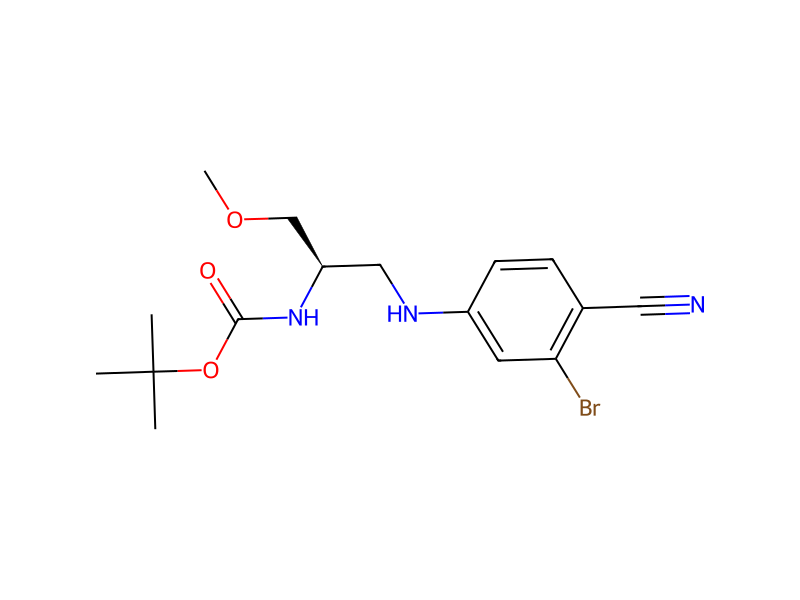
Diisopropylethylamine → (R)-tert-butyl 1-(3-bromo-4-cyanophenylamino)-3-methoxypropan-2-ylcarbamate
Reaction equation

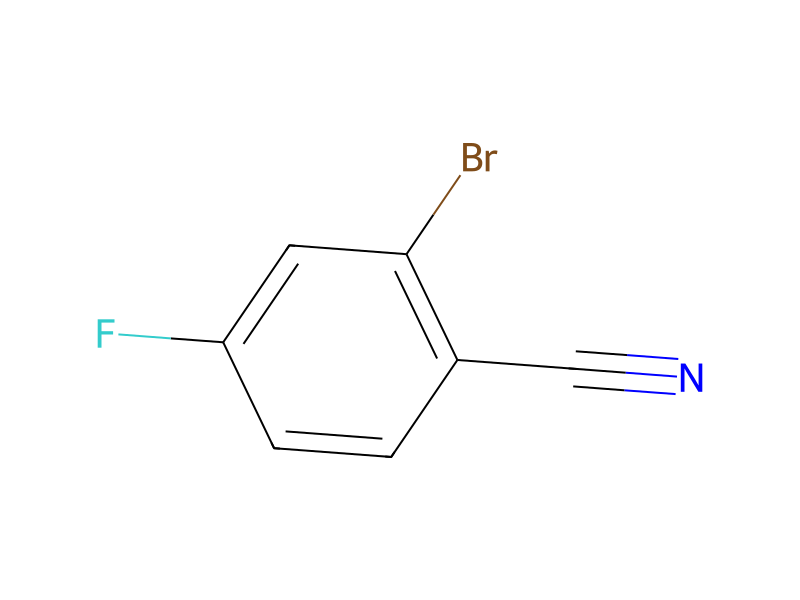
[Br:1][C:2]1[CH:9]=[C:8](F)[CH:7]=[CH:6][C:3]=1[C:4]#[N:5].[NH2:11][CH2:12][C@@H:13]([NH:17][C:18](=[O:24])[O:19][C:20]([CH3:23])([CH3:22])[CH3:21])[CH2:14][O:15][CH3:16].CCN(C(C)C)C(C)C>CS(C)=O.CCOC(C)=O>[Br:1][C:2]1[CH:9]=[C:8]([NH:11][CH2:12][C@@H:13]([NH:17][C:18](=[O:24])[O:19][C:20]([CH3:22])([CH3:21])[CH3:23])[CH2:14][O:15][CH3:16])[CH:7]=[CH:6][C:3]=1[C:4]#[N:5]Participants
6
Reactant 3


Product 1
Reagents, catalysts & solvents 2


Conditions
- Temperature
- 100 °C
Procedure
To a solution of 2-bromo-4-fluorobenzonitrile (0.2 g, 1 mmol) in DMSO (3 mL) was added (R)-tert-butyl 1-amino-3-methoxypropan-2-ylcarbamate (0.22 g, 1.08 mmol) and DIPEA (0.267 mL, 1.5 mmol). The mixture was heated at 100° C. for 15 h, and was diluted with EtOAc and washed with 1N HCl and Sat. NaHCO3. The organic phase was separated, dried over Na2SO4, concentrated in vacuo to give (R)-tert-butyl 1-(3-bromo-4-cyanophenylamino)-3-methoxypropan-2-ylcarbamate (0.3 g).
Workup
- washwashed with 1N HCl and Sat. NaHCO3
- customThe organic phase was separated
- dry with materialdried over Na2SO4
- concentrationconcentrated in vacuo
Sources & evidence
- ORD record
- ord-ccf7ddd57a9a423f905d3cd13c716aeb
- Source dataset
- uspto-grants-2016_06
- Patent number
- US09359375B2
Reaction notes
Loading…