P-Phenylenediamine → Benzyl N-(4-aminophenyl)carbamate
Reaction equation
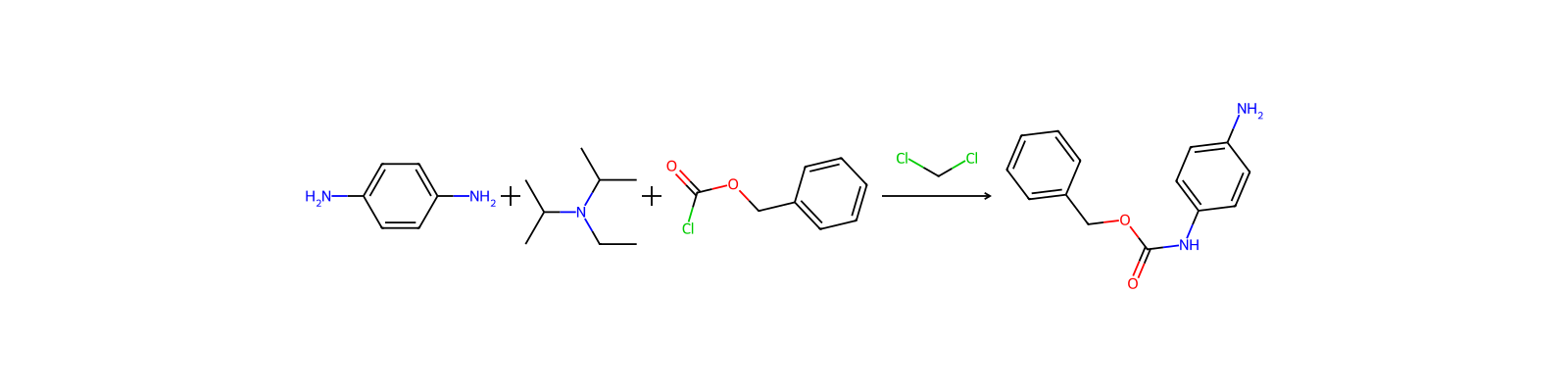
[C:1]1([NH2:8])[CH:6]=[CH:5][C:4]([NH2:7])=[CH:3][CH:2]=1.C(N(C(C)C)CC)(C)C.Cl[C:19]([O:21][CH2:22][C:23]1[CH:28]=[CH:27][CH:26]=[CH:25][CH:24]=1)=[O:20]>ClCCl>[CH2:22]([O:21][C:19](=[O:20])[NH:7][C:4]1[CH:5]=[CH:6][C:1]([NH2:8])=[CH:2][CH:3]=1)[C:23]1[CH:28]=[CH:27][CH:26]=[CH:25][CH:24]=1Participants
5
Reactant 3



Product 1

Reagents, catalysts & solvents 1

Conditions
- Temperature
- 0 °C
Procedure
1,4-Phenylenediamine (10 g, 0.093 mol) was stirred rapidly in dichloromethane (800 mL) with diisopropylethylamine (16 mL, 0.093 mol) and the solution cooled to 0° C. A solution of benzyl chloroformate (13 mL, 0.093 mol) in dichloromethane (100 mL) was added very slowly via a dropping funnel. The reaction was left to warm to room temperature over 16 h and concentrated in vacuo. The remaining residue was purified by column chromatography on silica eluting with ethyl acetate/petroleum ether (using a gradient from 25% to 80%) to give 1 as a cream solid (15.5 g, 69.6%). 1H NMR (CDCl3, 400 MHz) δ 3.56 (s(br), 2H, NH2), 5.18 (s, 2H, CH2), 6.45 (s(br), 1H, NH), 6.64 (d, 2H, J=8.8 Hz, ArH), 7.15 (d, 2H, J=6.9 Hz, ArH), 7.36 (m, 5H, ArH).
Workup
- waitThe reaction was left
- temperatureto warm to room temperature over 16 h
- concentrationconcentrated in vacuo
- customThe remaining residue was purified by column chromatography on silica eluting with ethyl acetate/petroleum ether (
Sources & evidence
- ORD record
- ord-2e995e1f33fe4e9ca569f8aa1da770c0
- Source dataset
- uspto-grants-2016_06
- Patent number
- US09365508B2
Reaction notes
Loading…