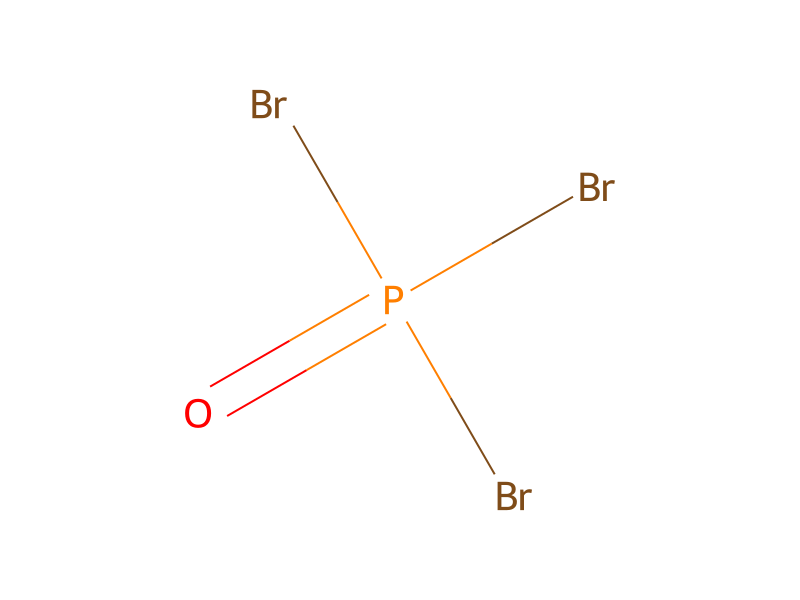
Phosphorus oxybromide → HCID 21946016, compound
Reaction equation

[Cl:1][C:2]1[N:7]=[C:6]([Cl:8])[C:5]([CH:9](O)[CH2:10][CH3:11])=[CH:4][N:3]=1.C(N(C(C)C)CC)(C)C.P(Br)(Br)([Br:24])=O>C(OCC)(=O)C>[Br:24][CH:9]([C:5]1[C:6]([Cl:8])=[N:7][C:2]([Cl:1])=[N:3][CH:4]=1)[CH2:10][CH3:11]Participants
Reactant 3


Product 1

Reagents, catalysts & solvents 1

Procedure
A solution of (±)-1-(2,4-dichloro-pyrimidin-5-yl)-propan-1-ol (0.26 g; 1.26 mmol) (from Example 7a supra) in diisopropylethylamine (0.55 mL; 3.13 mmol) (Aldrich) was cooled slightly (18° C.) to help offset the exothermicity of the reaction. Neat phosphorus oxybromide (0.35 g; 1.36 mmol) (Aldrich) was added in one portion. The cooling bath was removed and reaction mixture stirred at room temperature. After 15 minutes, the reaction mixture was diluted with ice and ethyl acetate. The organic phase was then washed with brine, dried over anhydrous sodium sulfate, filtered and concentrated. Purification by flash chromatography (Biotage 12M; 5:95 ethyl acetate-hexanes) gave crude (±)-5-(1-bromopropyl)-2,4-dichloro-pyrimidine which was used in subsequent steps without further purification. (Yield 0.23 g). The material showed 3 peaks for the pyrimidine ring proton in its NMR spectrum indicating some displacement of the ring chlorines with bromine.
Workup
- customthe exothermicity of the reaction
- customThe cooling bath was removed
- customreaction mixture
- washThe organic phase was then washed with brine
- dry with materialdried over anhydrous sodium sulfate
- filtrationfiltered
- concentrationconcentrated
- customPurification by flash chromatography (Biotage 12M; 5:95 ethyl acetate-hexanes)
Sources & evidence
- ORD record
- ord-4bea6fb94be547068ebff24bbb3a440f
- Source dataset
- uspto-grants-2006_09
- Patent number
- US07112676B2
Reaction notes
Loading…