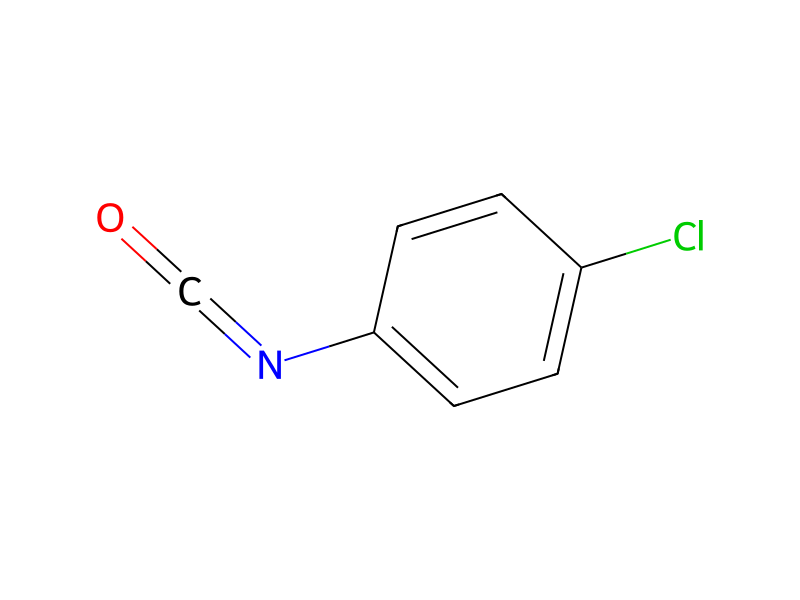
4-Chlorophenyl Isocyanate → HCID 69202950, compound
Reaction equation

Cl.[NH2:2][CH2:3][C:4]#[C:5][C:6]1[CH:15]=[CH:14][C:9]([C:10]([O:12][CH3:13])=[O:11])=[CH:8][CH:7]=1.[Cl:16][C:17]1[CH:22]=[CH:21][C:20]([N:23]=[C:24]=[O:25])=[CH:19][CH:18]=1.C(N(CC)CC)C>C1COCC1.C(OCC)(=O)C>[Cl:16][C:17]1[CH:22]=[CH:21][C:20]([NH:23][C:24](=[O:25])[NH:2][CH2:3][C:4]#[C:5][C:6]2[CH:15]=[CH:14][C:9]([C:10]([O:12][CH3:13])=[O:11])=[CH:8][CH:7]=2)=[CH:19][CH:18]=1Participants
6
Reactant 3


Product 1

Reagents, catalysts & solvents 2


Procedure
To a solution of methyl 4-(3-aminoprop-1-ynyl)benzoate hydrochloride (see Example 1, Steps 1-3 above; 150 mg, 0.66 mmol) in THF (5 ml) was added 4-chlorophenyl isocyanate (102 mg, 0.66 mmol) and triethylamine (278 μL, 2.0 mmol). The reaction mixture was stirred for 30 min, diluted with ethyl acetate (50 ml), and sequentially washed with water (25 ml), 0.5M aqueous HCl (25 ml), saturated sodium bicarbonate (25 ml), and finally with brine (25 ml). The organic phase was dried over sodium sulfate and concentrated in vacuo to provide methyl 4-[3-(3-(4-chlorophenyl)-ureido)prop-1-ynyl]-benzoate as a white solid.
Workup
- washsequentially washed with water (25 ml), 0.5M aqueous HCl (25 ml), saturated sodium bicarbonate (25 ml)
- dry with materialThe organic phase was dried over sodium sulfate
- concentrationconcentrated in vacuo
Sources & evidence
- ORD record
- ord-8f8396547e26496d891b3d2e124cc55e
- Source dataset
- uspto-grants-2008_05
- Patent number
- US07368572B2
Reaction notes
Loading…