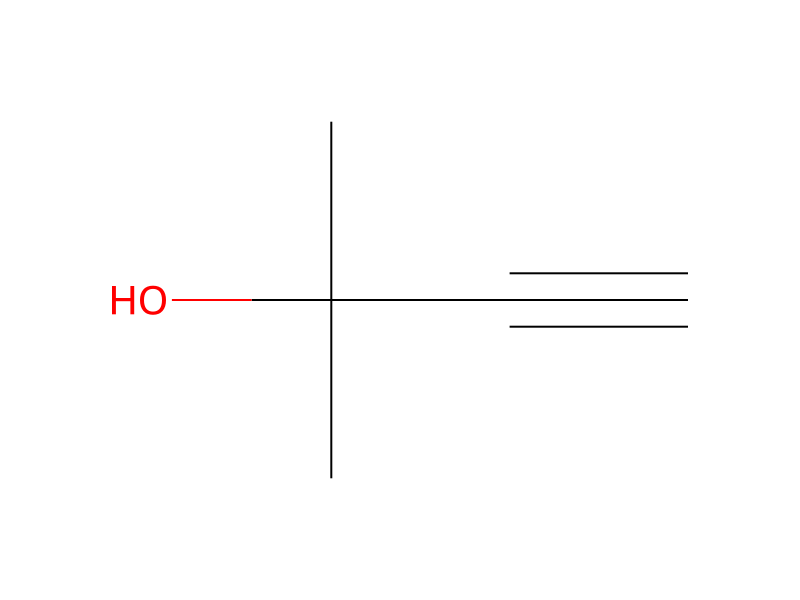
2-Methyl-3-butyn-2-ol → 2-Methyl-6-phenyl-hexa-3,5-diyn-2-ol
Reaction equation

Br[C:2]#[C:3][C:4]1[CH:9]=[CH:8][CH:7]=[CH:6][CH:5]=1.C(=O)([O-])[O-].[K+].[K+].C1(P(C2C=CC=CC=2)C2C=CC=CC=2)C=CC=CC=1.[CH3:35][C:36]([OH:40])([C:38]#[CH:39])[CH3:37]>[Pd].[Cu](I)I.COCCOC>[CH3:35][C:36]([OH:40])([C:38]#[C:39][C:2]#[C:3][C:4]1[CH:9]=[CH:8][CH:7]=[CH:6][CH:5]=1)[CH3:37]Participants
8
Reactant 4



Product 1

Reagents, catalysts & solvents 3



Conditions
- Temperature
- 100 °C
Procedure
A mixture of bromophenylacetylene (5.0 g, 27.6 mmol), potassium carbonate (9.54 g, 69.0 mmol), copper iodide (0.54 g, 2.8 mmol), palladium on carbon (5%, 500 mg), triphenylphosphine (0.72 g, 2.8 mmol), 2-methyl-3-butyn-2-ol (11.6 g, 138 mmol) and 1,2-dimethoxyethane (100 ml) was stirred overnight at 100° C. The product mixture was evaporated. Chromatography on silica gel with petroleum and ethyl acetate (2:1), gave the title compound. Yield 1.06 g (21%).
Workup
- customThe product mixture was evaporated
Sources & evidence
- ORD record
- ord-160d57698849480fbb24a65e165d1cd3
- Source dataset
- uspto-grants-2008_05
- Patent number
- US07378526B2
Reaction notes
Loading…