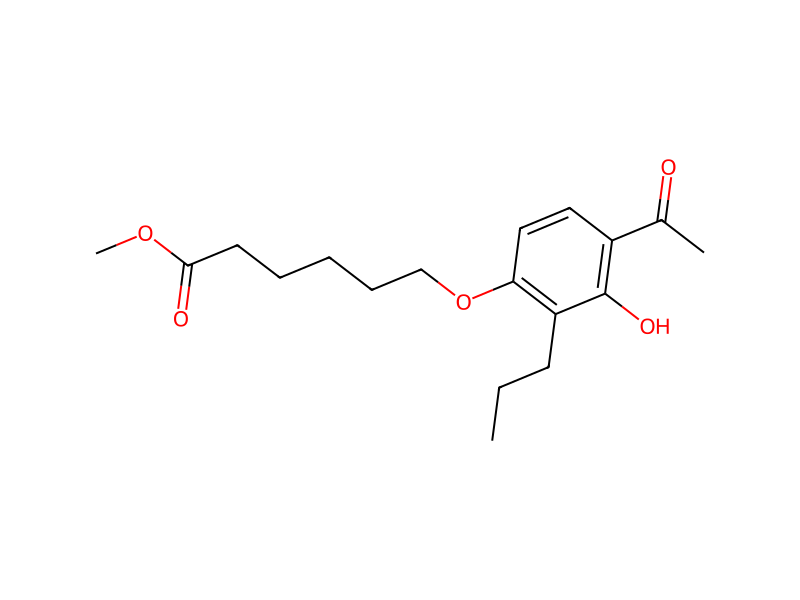
1,3-Dibromopropane → 6-[4-Acetyl-3-(3-bromopropoxy)-2-propylphenoxy]hexanoic acid methyl ester
Reaction equation

[CH3:1][O:2][C:3](=[O:23])[CH2:4][CH2:5][CH2:6][CH2:7][CH2:8][O:9][C:10]1[CH:15]=[CH:14][C:13]([C:16](=[O:18])[CH3:17])=[C:12]([OH:19])[C:11]=1[CH2:20][CH2:21][CH3:22].[Br:24][CH2:25][CH2:26][CH2:27]Br.C(=O)([O-])[O-].[K+].[K+]>CC(C)=O>[CH3:1][O:2][C:3](=[O:23])[CH2:4][CH2:5][CH2:6][CH2:7][CH2:8][O:9][C:10]1[CH:15]=[CH:14][C:13]([C:16](=[O:18])[CH3:17])=[C:12]([O:19][CH2:27][CH2:26][CH2:25][Br:24])[C:11]=1[CH2:20][CH2:21][CH3:22]Participants
5




Procedure
A mixture of 6.0 g of 6-(4-acetyl-3-hydroxy-2-propylphenoxy)hexanoic acid methyl ester, 19 ml of 1,3-dibromopropane and 2.0 g of anhydrous potassium carbonate in 175 ml of anhydrous acetone was stirred at reflux for 52 hours. The reaction mixture was concentrated in vacuo to give 8.1 g (98% yield) of 6-[4-acetyl-3-(3-bromopropoxy)-2-propylphenoxy]hexanoic acid methyl ester as an oil.
Workup
- temperatureat reflux for 52 hours
- concentrationThe reaction mixture was concentrated in vacuo
Sources & evidence
- ORD record
- ord-81e2ceca30f942979c9c2fe9bc15a9fc
- Source dataset
- uspto-grants-1988_11
- Patent number
- US04782176
Reaction notes
Loading…