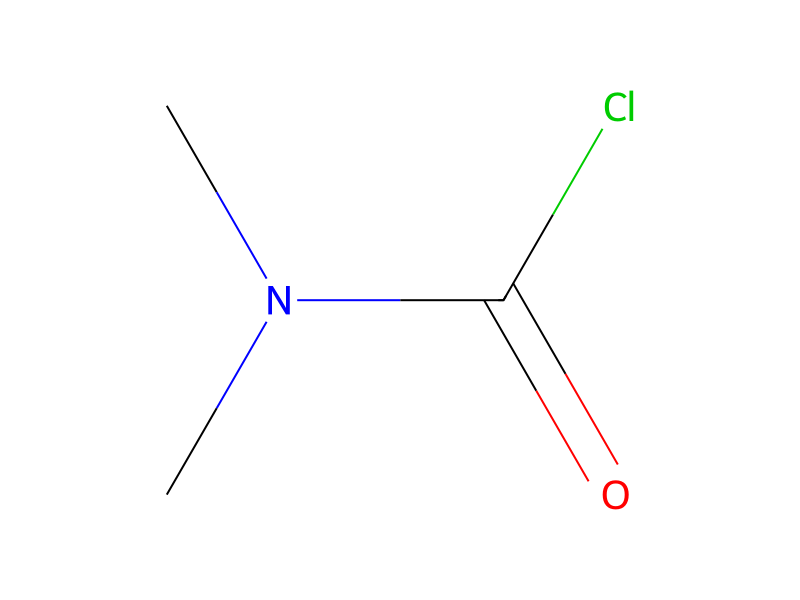
Dimethylcarbamoyl Chloride → 3-Cyclopropylpyridine-2-carbonitrile
Reaction equation

[CH:1]1([C:4]2[CH:5]=[N+:6]([O-])[CH:7]=[CH:8][CH:9]=2)[CH2:3][CH2:2]1.C[Si]([C:15]#[N:16])(C)C.CN(C)C(Cl)=O.C(=O)([O-])[O-].[K+].[K+]>C(Cl)(Cl)Cl>[CH:1]1([C:4]2[C:5]([C:15]#[N:16])=[N:6][CH:7]=[CH:8][CH:9]=2)[CH2:3][CH2:2]1Participants




Procedure
1.47 g of 3-cyclopropylpyridine-1-oxide [121-1] was dissolved in 15 mL of chloroform, and 1.89 mL of trimethylsilyl cyanide was added thereto. Subsequently, a solution prepared by dissolving 1.3 mL of dimethylcarbamoyl chloride in 5 mL of chloroform was added dropwise over 30 minutes, and was stirred overnight at room temperature. Thereto, 10 mL of 10% aqueous solution of potassium carbonate was added, and the mixture was extracted with chloroform. The organic layer was washed with saturated brine, and dried over anhydrous sodium sulfate. The insolubles were filtered and the filtrate was concentrated under reduced pressure, to obtain a residue. The residue was purified by silica gel column chromatography, and 680 mg of 3-cyclopropylpyridine-2-carbonitrile [121-2] was obtained as a white solid.
Workup
- customSubsequently, a solution prepared
- additionwas added dropwise over 30 minutes
- extractionthe mixture was extracted with chloroform
- washThe organic layer was washed with saturated brine
- dry with materialdried over anhydrous sodium sulfate
- filtrationThe insolubles were filtered
- concentrationthe filtrate was concentrated under reduced pressure
- customto obtain a residue
- customThe residue was purified by silica gel column chromatography
Sources & evidence
- ORD record
- ord-510a60675709422a82d5de9ac39d5b04
- Source dataset
- uspto-grants-2010_05
- Patent number
- US07718801B2
Reaction notes
Loading…