4-Toluenesulfonyl chloride → 2,3-Dicyano-1,4-phenylene bis(4-methylbenzene-1-sulfonate)
Reaction equation

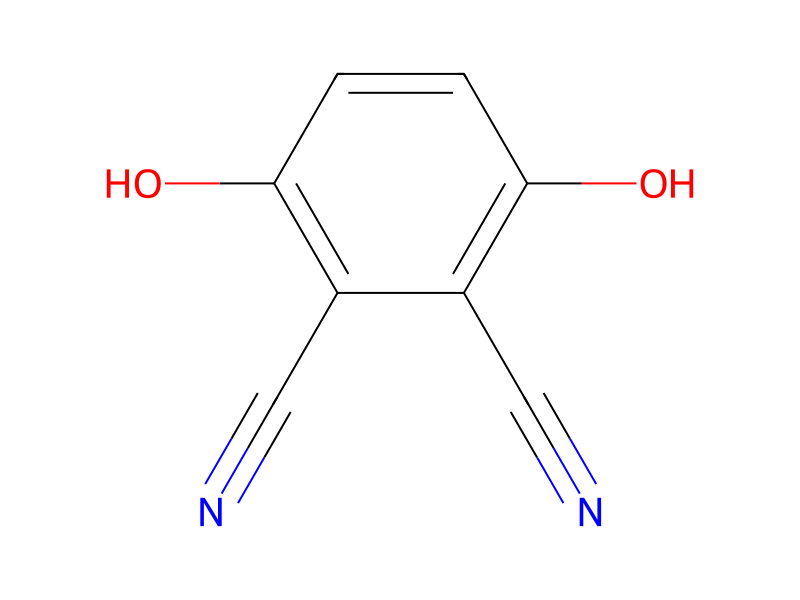
[C:1]1([CH3:11])[CH:6]=[CH:5][C:4]([S:7](Cl)(=[O:9])=[O:8])=[CH:3][CH:2]=1.[C:12]([C:14]1[C:20]([C:21]#[N:22])=[C:19]([OH:23])[CH:18]=[CH:17][C:15]=1[OH:16])#[N:13].C(=O)([O-])[O-].[K+].[K+]>CC(C)=O>[CH3:11][C:1]1[CH:6]=[CH:5][C:4]([S:7]([O:23][C:19]2[CH:18]=[CH:17][C:15]([O:16][S:7]([C:4]3[CH:5]=[CH:6][C:1]([CH3:11])=[CH:2][CH:3]=3)(=[O:9])=[O:8])=[C:14]([C:12]#[N:13])[C:20]=2[C:21]#[N:22])(=[O:9])=[O:8])=[CH:3][CH:2]=1Participants
Reactant 3


Product 1

Reagents, catalysts & solvents 1

Procedure
p-Toluenesulfonyl chloride (25.80 g, 135 mmol) was added to a suspension of 2,3-dicyanohydroquinone (10.00 g, 62.5 mmol) and potassium carbonate (34.50 g, 250 mmol) in acetone (75 mL). The temperature of the flask rose rapidly, which stabilised after 2 minutes. The mixture was then heated to reflux and stirred for 2 hours. TLC (eluting: CH2Cl2) indicated that all the starting 2,3-dicyanohydroquinone had been consumed. The mixture was allowed to cool to room temperature, and was poured into water (200 mL), and the mixture stirred for 1 hour. Filtration gave the title compound (Product A) as a colourless solid, which was washed with more water (˜30 mL) and pulled dry. The solid was then dried in an oven (28.36 g, 97%). This material was used without further purification. [Found: C, 55.8%; H, 3.3%; N, 6.0%; S, 13.5%; C22H16O6N2S2 requires C, 56.4%; H, 3.4%; N, 6.0%; S, 13.7%]; MS (EI+) 468 (M+, 80%), 155 (CH3C6H4SO2, 100%), 91 (CH3C6H4, 90%).
Workup
- temperatureThe mixture was then heated
- temperatureto reflux
- washTLC (eluting: CH2Cl2)
- customhad been consumed
- additionwas poured into water (200 mL)
- stirringthe mixture stirred for 1 hour
- filtrationFiltration
Sources & evidence
- ORD record
- ord-06ecc1da7dbe4a3482e6a1d02dc0a08d
- Source dataset
- uspto-grants-2008_01
- Patent number
- US07314511B2
Reaction notes
Loading…