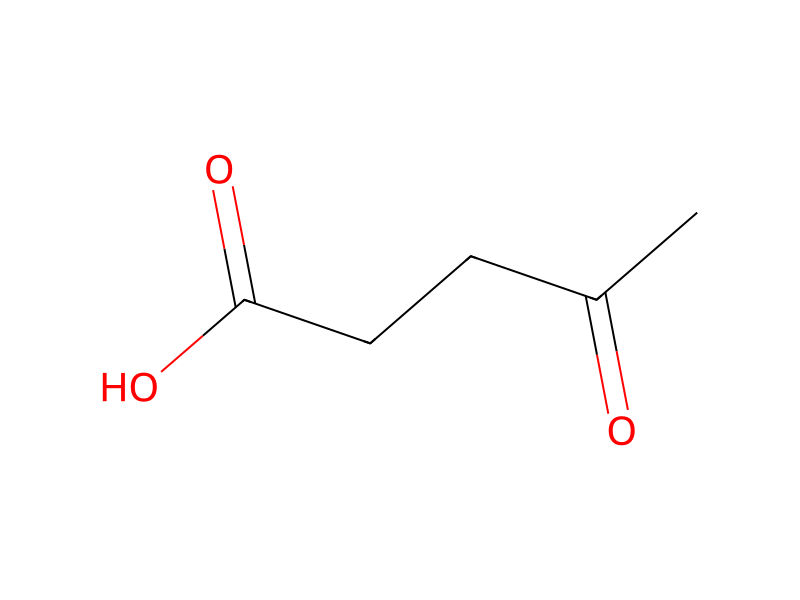
Aminolevulinic Acid Hydrochloride → Levulinic Acid
Reaction equation

[N:1]([CH2:4][C:5](=[O:11])[CH2:6][CH2:7][C:8]([OH:10])=[O:9])=[N+]=[N-].[ClH:12].N[CH2:14][C:15](=[O:21])[CH2:16][CH2:17][C:18]([OH:20])=[O:19]>Cl.[Pd].[Pt]>[ClH:12].[NH2:1][CH2:4][C:5](=[O:11])[CH2:6][CH2:7][C:8]([OH:10])=[O:9].[C:18]([OH:20])(=[O:19])[CH2:17][CH2:16][C:15]([CH3:14])=[O:21]Participants
7





Procedure
In the following step, the key compound 5-azido levulinic acid will be reduced to 5-amino levulinic acid hydrochloride without any difficulties. The reduction is preferably carried out as a catalytic hydrogenation in the presence of a metal catalyst (preferably palladium or platinum on a suitable carrier, such as active carbon) in aqueous hydrochloric acid without any arise of undesireable organic by-products. The catalyst can be regenarated. 5-Amino levulinic acid hydrochloride is obtained absolutly pure with an overall yield of 31-35% (starting from levulinic acid).
Sources & evidence
- ORD record
- ord-938f8ee9be90431f97f603f0a8be32f9
- Source dataset
- uspto-grants-2008_01
- Patent number
- US07319164B2
Reaction notes
Loading…