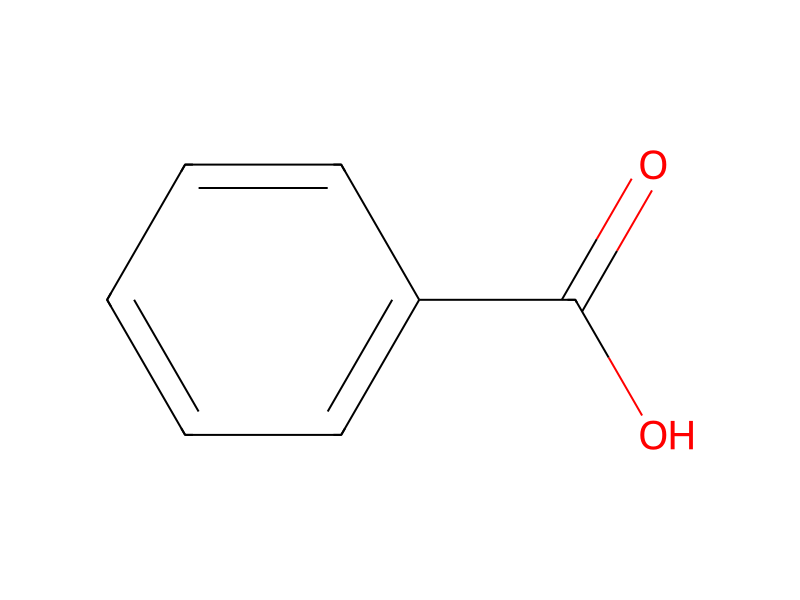
Acetic Acid → Benzoic Acid
Reaction equation

[Br-].[Na+].[C:3]([OH:6])(=[O:5])[CH3:4].OO.[C:9]1(C)[CH:14]=[CH:13]C=[CH:11][CH:10]=1>O.O.O.O.C([O-])(=O)C.[Co+2].C([O-])(=O)C>[CH:3](=[O:6])[C:4]1[CH:13]=[CH:14][CH:9]=[CH:10][CH:11]=1.[C:3]([OH:6])(=[O:5])[C:4]1[CH:13]=[CH:14][CH:9]=[CH:10][CH:11]=1Participants
7
Reactant 4




Product 2

Reagents, catalysts & solvents 1

Conditions
- Temperature
- 80 °C
Procedure
Cobalt (II) acetate tetrahydrate (lg, 0.004 moles), sodium bromide (lg, 0.01 moles), toluene (0.054 moles) and acetic acid (55 g) were charged to a vessel fitted with an overhead paddle stirrer, thermometer and condenser and heated to 80° C. Hydrogen peroxide (40%, 0.44 moles) was added dropwise down the condenser over 2 hours, during which time the reaction mixture changed colour from dark blue to pink. The reaction was continued for a further two hours when it was stopped and the reaction mixture analysed by HPLC. The analysis revealed that 90.6% of the toluene had been consumed, yielding products including benzaldehyde (29.0% yield) and benzoic acid (55.6% yield).
Workup
- customfitted with an overhead paddle stirrer
- customhad been consumed
- customyielding products
Sources & evidence
- ORD record
- ord-e26aa1430b614d799fad0288c0939d20
- Source dataset
- uspto-grants-1995_12
- Patent number
- US05473101
Reaction notes
Loading…