Triphenylphosphine → 4-(4-Bromo-phenylsulphanylmethyl)-5-methyl-furan-2-carboxylic acid methyl ester
Reaction equation

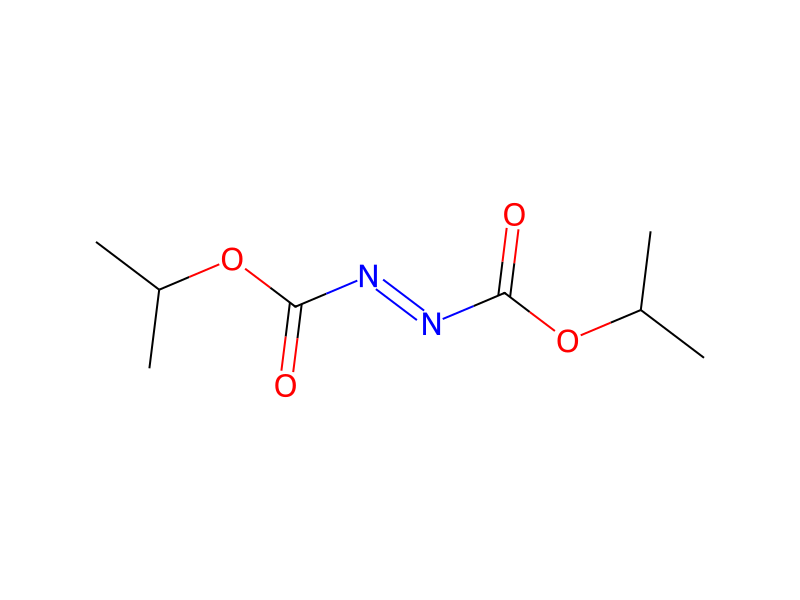
CC(OC(/N=N/C(OC(C)C)=O)=O)C.C1(P(C2C=CC=CC=2)C2C=CC=CC=2)C=CC=CC=1.[CH3:34][O:35][C:36]([C:38]1[O:39][C:40]([CH3:45])=[C:41]([CH2:43]O)[CH:42]=1)=[O:37].[Br:46][C:47]1[CH:52]=[CH:51][C:50]([SH:53])=[CH:49][CH:48]=1>O1CCCC1>[CH3:34][O:35][C:36]([C:38]1[O:39][C:40]([CH3:45])=[C:41]([CH2:43][S:53][C:50]2[CH:51]=[CH:52][C:47]([Br:46])=[CH:48][CH:49]=2)[CH:42]=1)=[O:37]Participants
Reactant 4



Product 1

Reagents, catalysts & solvents 1

Procedure
Diisopropylazodicarboxylate (1.27 g, 6.3 mmoles) was added to a solution of triphenylphosphine (1.65 g, 6.3 mmoles) in tetrahydrofuran (15 ml) with stirring and cooling in an ice/water bath. A solution of 4-hydroxymethyl-5-methyl-furan-2-carboxylic acid methyl ester (16) (536 mg, 3.15 mmoles) and 4-bromo-thiophenol (584 mg, 3.09 mmoles) in tetrahydrofuran (5 ml) was added and the mixture stirred for 30 minutes at 0° C. then 72 hours at room temperature. The solvent was evaporated and the residue extracted with heptane then diethyl ether. The extracts were combined and evaporated to give a yellow oil which was purified by flash chromatography using heptane/ethyl acetate 9:1 v/v as eluent. This gave compound 150 (600 mg) as a white solid. LC/MS System A; Rt=4.12 mins.
Workup
- temperaturecooling in an ice/water bath
- stirringthe mixture stirred for 30 minutes at 0° C.
- custom72 hours
- customat room temperature
- customThe solvent was evaporated
- extractionthe residue extracted with heptane
- customevaporated
- customto give a yellow oil which
- customwas purified by flash chromatography
Sources & evidence
- ORD record
- ord-286df1e0744445d0adbdafda03c91e26
- Source dataset
- uspto-grants-2010_12
- Patent number
- US07858644B2
Reaction notes
Loading…