Hydrochloric Acid → 4-Benzyloxy-3-fluorophenylboronic Acid
Reaction equation

[CH2:1]([O:8][C:9]1[CH:14]=[CH:13][C:12](Br)=[CH:11][C:10]=1[F:16])[C:2]1[CH:7]=[CH:6][CH:5]=[CH:4][CH:3]=1.[B:17](OC(C)C)([O:22]C(C)C)[O:18]C(C)C.C([Li])CCC.Cl>O1CCCC1.CCCCCC>[CH2:1]([O:8][C:9]1[CH:14]=[CH:13][C:12]([B:17]([OH:22])[OH:18])=[CH:11][C:10]=1[F:16])[C:2]1[CH:7]=[CH:6][CH:5]=[CH:4][CH:3]=1Participants


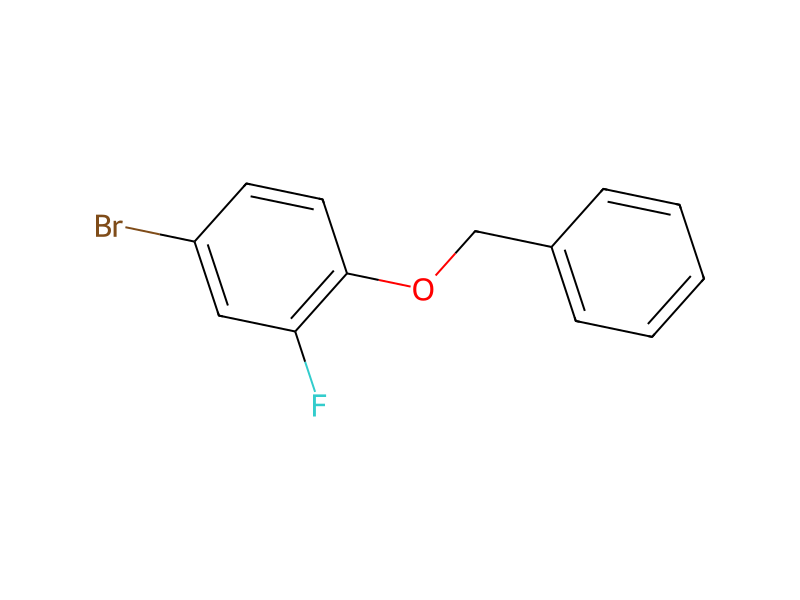




Conditions
- Temperature
- -78 °C
Procedure
Under nitrogen stream, 1-(benzyloxy)-4-bromo-2-fluorobenzene (12.0 g, 43 mmol) was dissolved in tetrahydrofuran, followed by addition of triisopropyl borate (11.8 mL, 51 mmol), and then the mixture was cooled to −78° C. Butyl lithium (1.55M hexane solution) (30 mL, 47 mmol) was slowly added dropwise, and the mixture was stirred for 1 hour at −78° C. A 1N aqueous hydrochloric acid solution (100 mL) was added to the reaction mixture, and the mixture was stirred for 1 hour at room temperature. The solvent was distilled off under reduced pressure. The aqueous phase was extracted with ethyl acetate, the extracted solution was dried over anhydrous magnesium sulfate, and then the solvent was distilled off under reduced pressure. The residue obtained was suspended in hexane, and was then collected by filtration to give the title compound (9.27 g, 88%).
Workup
- stirringthe mixture was stirred for 1 hour at room temperature
- distillationThe solvent was distilled off under reduced pressure
- extractionThe aqueous phase was extracted with ethyl acetate
- dry with materialthe extracted solution was dried over anhydrous magnesium sulfate
- distillationthe solvent was distilled off under reduced pressure
- customThe residue obtained
- filtrationwas then collected by filtration
Sources & evidence
- ORD record
- ord-5ed27ac5023340278aaa9a8374d4fdf8
- Source dataset
- uspto-grants-2015_09
- Patent number
- US09133140B2
Reaction notes
Loading…