4-Chlorobenzoic Acid → BIPHENYL-3,4'-DICARBOXYLIC ACID
Reaction equation

Cl[C:2]1[CH:10]=[CH:9][C:5]([C:6]([OH:8])=[O:7])=[CH:4][CH:3]=1.[C:11]([C:14]1[CH:15]=[C:16](B(O)O)[CH:17]=[CH:18][CH:19]=1)([OH:13])=[O:12].C([O-])([O-])=O.[K+].[K+]>CC([O-])=O.CC([O-])=O.[Pd+2].C1(P(C2CCCCC2)C2C=CC=CC=2C2C(OC)=CC=C(S([O-])(=O)=O)C=2OC)CCCCC1.[Na+].O>[C:10]1([C:17]2[CH:16]=[CH:15][C:14]([C:11]([OH:13])=[O:12])=[CH:19][CH:18]=2)[CH:2]=[CH:3][CH:4]=[C:5]([C:6]([OH:8])=[O:7])[CH:9]=1Participants
Reactant 3



Product 1

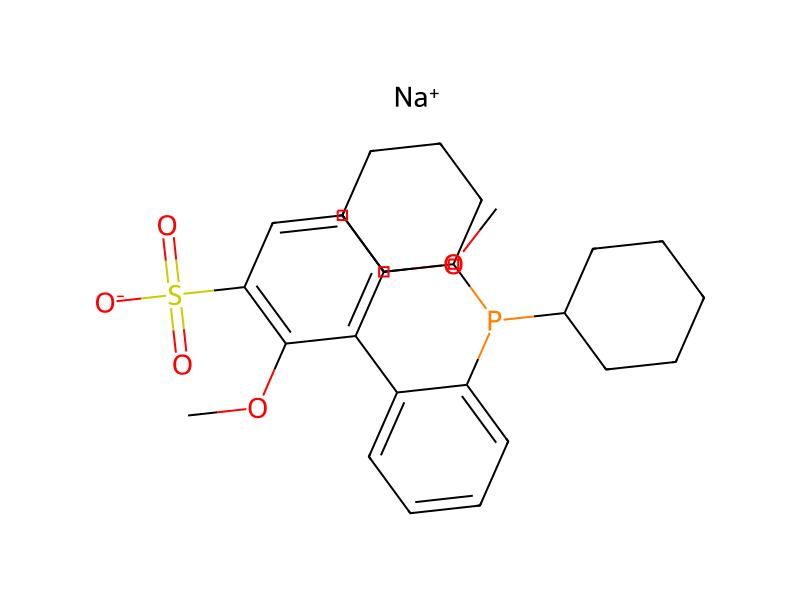
Reagents, catalysts & solvents 3


Procedure
Using microwave irradiation. The general procedure described in Example 3 was used with 4-chlorobenzoic acid (157 mg, 1.00 mmol), 3-carboxyphenylboronic acid (199 mg, 1.20 mmol), Pd(OAc)2 (2.2 mg, 0.010 mmol, 1 mol %), sodium 2-dicyclohexylphosphino-2′,6′-dimethoxybiphenyl-3′-sulfonate (10.0 mg, 0.020 mmol, 2 mol %), K2CO3 (414 mg, 3.00 mmol), water (3.0 mL), 10 min at 150° C. (using microwave irradiation with cooling). The product was isolated as a white solid (229 mg, 95%). Mp=>250° C. (lit. mp=295° C.). 1H NMR (400 MHz, d6-DMSO/D2O) δ: 8.22 (s, 1H), 8.42 (d, 2H, J=7.6 Hz), 7.98 (d, 1H, J=7.6 Hz), 7.91 (d, 1H, J=7.6 Hz), 7.79 (d, 2H, J=7.6 Hz), 7.59 (t, 1H, J=7.2 Hz). 13C NMR (125 MHz, d6-DMSO/D2O) δ: 167.5, 143.6, 139.7, 131.9, 131.7, 130.4, 130.3, 129.8, 129.4, 127.8, 127.2.
Workup
- custommicrowave irradiation
- custom(using microwave irradiation with cooling)
Sources & evidence
- ORD record
- ord-b27e7edf0fa7496f9d3229fcb325684e
- Source dataset
- uspto-grants-2009_07
- Patent number
- US07560596B2
Reaction notes
Loading…