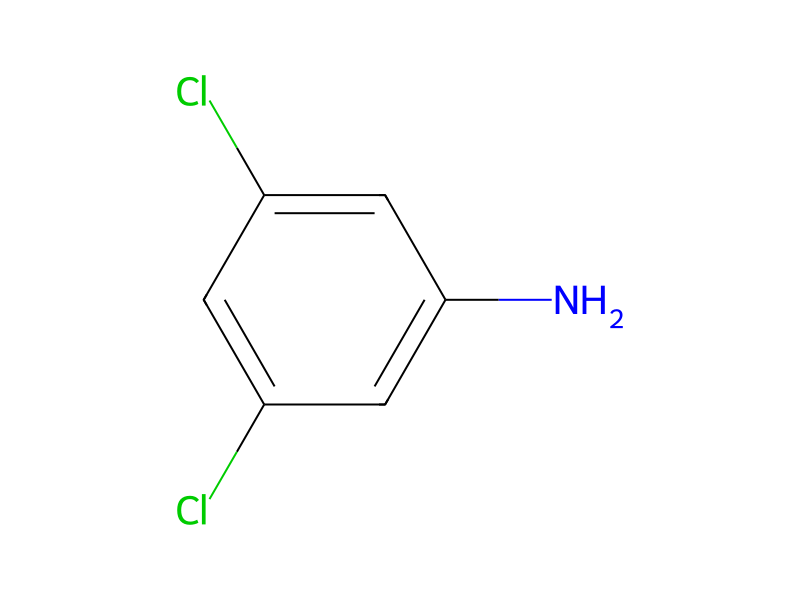
Phenol → 3,5-Dichloroaniline
Reaction equation

C1(O)C=CC=CC=1.[Cl:8][C:9]1[C:15]([Cl:16])=[CH:14][C:13]([Cl:17])=[C:12]([Cl:18])[C:10]=1[NH2:11].I.[H][H].[OH-].[Na+]>[Pt].O.[Ta].C1(C)C=CC=CC=1>[Cl:16][C:15]1[CH:9]=[C:10]([CH:12]=[C:13]([Cl:17])[CH:14]=1)[NH2:11].[Cl:8][C:9]1[C:15]([Cl:16])=[CH:14][C:13]([Cl:17])=[C:12]([Cl:18])[C:10]=1[NH2:11]Participants
Reactant 5





Product 2
Reagents, catalysts & solvents 4




Conditions
- Temperature
- 155 °C
Procedure
200 parts of phenol, 197 parts of 2,3,5,6-tetrachloroaniline, 20 parts of platinum-on-charcoal catalyst (3.7% strength) and 15 parts of aqueous hydroiodic acid (57% strength) are dehalogenated with hydrogen in a tantalum autoclave (0.85 l) during the course of 3.5 hours, whilst stirring, under a maximum pressure of 50 bars and at 155° C. After cooling of the reaction vessel and after releasing the pressure, the reaction mixture is diluted with 500 parts by volume of water, made alkaline with concentrated sodium hydroxide solution, mixed with toluene and separated from the platinum-on-charcoal catalyst by filtration under suction. The organic phase obtained by layer separation is freed from the solvent by distillation. 99.3% strength, 3,5-dichloroaniline is obtained in a yield of 97%, with complete conversion of 2,3,5,6-tetrachloroaniline, by distillation over a simple distillation bridge.
Workup
- temperatureAfter cooling of the reaction vessel
- customseparated from the platinum-on-charcoal catalyst by filtration under suction
- customThe organic phase obtained by layer separation
- distillationis freed from the solvent by distillation
Sources & evidence
- ORD record
- ord-c7d6e228eee54ab399486f77e80d182f
- Source dataset
- uspto-grants-1984_01
- Patent number
- US04429156
Reaction notes
Loading…