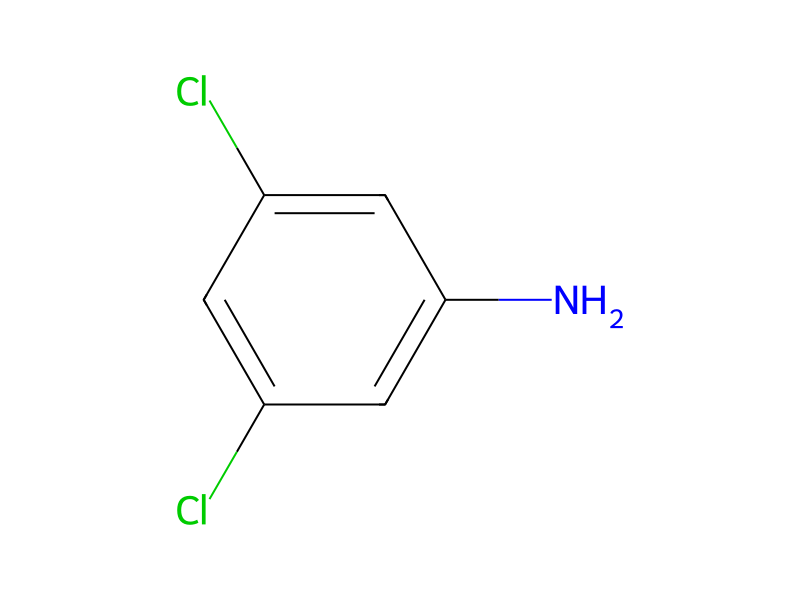
Hydrochloric Acid → 3,5-Dichloroaniline
Reaction equation

C1(O)C=CC=CC=1.ClC1C(Cl)=C(C=CC=1)N(Cl)Cl.Cl[C:20]1[C:25]([NH2:26])=[C:24](Cl)[C:23]([Cl:28])=[C:22](Cl)[C:21]=1[Cl:30].Cl.[H][H]>[Ta]>[Cl:28][C:23]1[CH:24]=[C:25]([CH:20]=[C:21]([Cl:30])[CH:22]=1)[NH2:26]Participants
6
Reactant 4




Product 1
Reagents, catalysts & solvents 1
Procedure
200 parts of phenol, 131 parts of a tetrachloroaniline/pentachloroaniline mixture corresponding to the composition mentioned in Example 3, 1 part of ruthenium-on-charcoal catalyst (5% strength) which has already been used for 10 previous similar experiments, and 12 parts of aqueous hydrochloric acid (57% strength) are reacted in a tantalum autoclave, during the course of 3.5 hours at 165° C., whilst stirring, at a hydrogen pressure of 50 bars. After the usual working up, 90 parts of 99% strength 3,5-dichloroaniline are isolated. Yield: 97% of theory.
Sources & evidence
- ORD record
- ord-0be853c85c9b424da3a64e0abd8023db
- Source dataset
- uspto-grants-1984_01
- Patent number
- US04429156
Reaction notes
Loading…