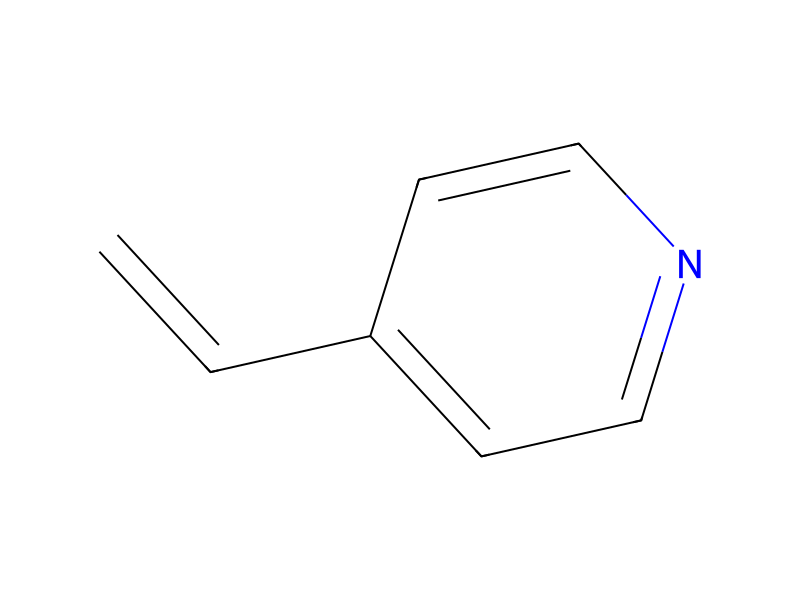
4-Vinylpyridine → HCID 22607319, compound
Reaction equation

Br[C:2]1[CH:3]=[N:4][CH:5]=[C:6]([Br:8])[CH:7]=1.[CH:9]([C:11]1[CH:16]=[CH:15][N:14]=[CH:13][CH:12]=1)=[CH2:10].C1(C)C=CC=CC=1P(C1C=CC=CC=1C)C1C=CC=CC=1C.C(N(CC)CC)C>C(#N)C.C([O-])(=O)C.[Pd+2].C([O-])(=O)C>[Br:8][C:6]1[CH:5]=[N:4][CH:3]=[C:2](/[CH:10]=[CH:9]/[C:11]2[CH:16]=[CH:15][N:14]=[CH:13][CH:12]=2)[CH:7]=1Participants
7






Procedure
A solution of 3,5-dibromopyridine (5.56 g, 23.4 mmol), 4-vinylpyridine (5.1 mL), palladium acetate (1.05 g), tri-o-tolylphosphine (5.00 g) and triethylamine (33 mL) in acetonitrile (100 mL) was heated overnight at 80° C. and concentrated. The residue was partitioned between 5% NaHCO3 and dichloromethane and filtered. The filtrate was separated and the organic layer was washed with water, dried (MgSO4), filtered, and concentrated. The concentrate was purified by flash column chromatography on silica gel with 4% methanol/dichloromethane to provide the desired product (2.18 g, 36%). (DCI/NH3) m/e 261, 263 (M+H)+.
Workup
- concentrationconcentrated
- customThe residue was partitioned between 5% NaHCO3 and dichloromethane
- filtrationfiltered
- customThe filtrate was separated
- washthe organic layer was washed with water
- dry with materialdried (MgSO4)
- filtrationfiltered
- concentrationconcentrated
- customThe concentrate was purified by flash column chromatography on silica gel with 4% methanol/dichloromethane
Sources & evidence
- ORD record
- ord-0cf1e474c2d04d95963c2f1308d11c37
- Source dataset
- uspto-grants-2004_12
- Patent number
- US06831175B2
Reaction notes
Loading…