Acetic Acid → Sorbitol
Reaction equation

[BH4-].[Na+].[C:3]([OH:6])(=O)[CH3:4].Cl.[OH2:8]>>[O:8]=[CH:4][C@@H:3]([C@H:4]([C@@H:3]([C@@H:4]([CH2:3][OH:6])[OH:8])[OH:6])[OH:8])[OH:6].[CH2:3]([OH:6])[C@@H:4]([C@H:3]([C@@H:4]([C@@H:4]([CH2:3][OH:6])[OH:8])[OH:8])[OH:6])[OH:8]Participants




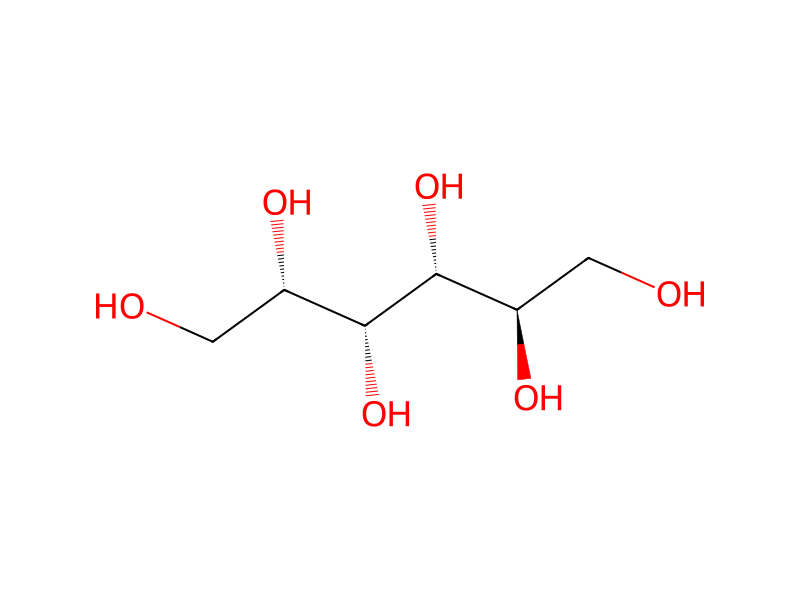

Procedure
To a mixture of 30 μl of the sample, 100 μl of 0.3% sodium borohydride in water was added. After standing for 3 hours at room temperature, 50 μl of 2M acetic acid was added to the solution to decompose excess reducing reagent. The lyophilized sample was methanolyzed with 0.5 ml of 1.5N anhydrous methanolic hydrochloric acid at 90° C. for 4 hours. The methanolysate was evaporated in vacuo, and the residue was trimethylsilyated in pyridine with hexamethyldisilazane and trimethylsilyl chloride for 1 hour at room temperature. The column for gas-liquid chromatography was packed with 2% OV-17 on Chromosorb W, 80-100 mesh (0.5×300 cm). The temperature was programmed from 120° C. to 185° C. at the rate of 4° C. increment per min. Using maltose operated in the same manner as standard, the number of glucose of 1, 2, 3, 4 and 5 in each fraction were obtained from the molar ratio of glucose to glucitol. From this, the number of glucose units in the oligosaccharide of 3, 4, 5, 6 and 7 was determined (hereinafter referred to as "FG3, FG4, FG5, FG6 and FG7", respectively).
Workup
- additionwas added
- customThe methanolysate was evaporated in vacuo
- waitthe residue was trimethylsilyated in pyridine with hexamethyldisilazane and trimethylsilyl chloride for 1 hour at room temperature
- customwas programmed from 120° C. to 185° C. at the rate of 4° C. increment per min
Sources & evidence
- ORD record
- ord-1c9f4c2243fd42e4a5a8d78463fe742e
- Source dataset
- uspto-grants-1987_09
- Patent number
- US04697006
Reaction notes
Loading…