Hydrochloric Acid → 7-Chloro-N-[3-(1-pyrrolidinyl)propyl]-4-quinolinamine
Reaction equation

Cl[C:2]1[C:11]2[C:6](=[CH:7][C:8]([Cl:12])=[CH:9][CH:10]=2)[N:5]=[CH:4][CH:3]=1.[N:13]1([CH2:18][CH2:19][CH2:20][NH2:21])[CH2:17][CH2:16][CH2:15][CH2:14]1.Cl.C1(N)C(F)=C(F)C(F)=C(N)C=1F.Cl.Cl>>[Cl:12][C:8]1[CH:7]=[C:6]2[C:11]([C:2]([NH:21][CH2:20][CH2:19][CH2:18][N:13]3[CH2:17][CH2:16][CH2:15][CH2:14]3)=[CH:3][CH:4]=[N:5]2)=[CH:10][CH:9]=1Participants
5

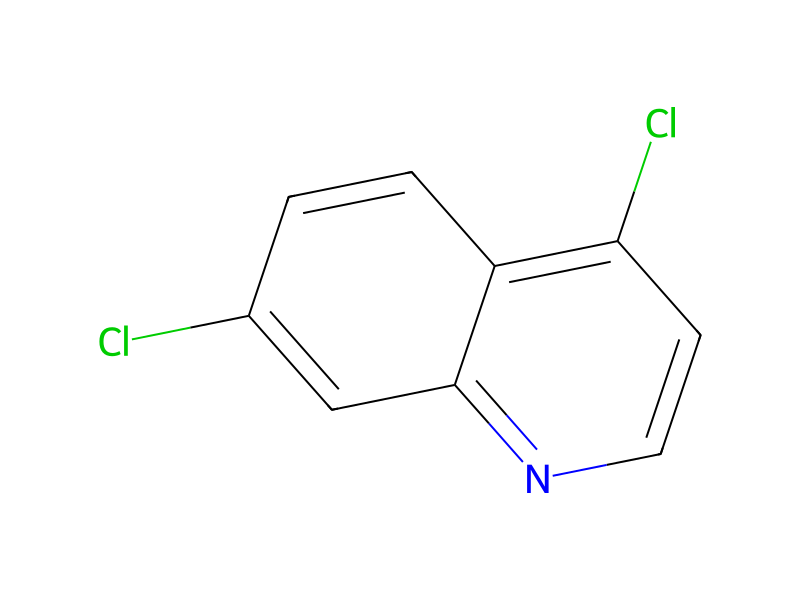


Procedure
3.08 g from 7.72 g of 4,7-dichloroquinoline and 5 g of 3-(pyrrolidin-1-yl)-propylamine (reaction duration 16 hours at 140° C.); the base was converted with isopropanolic hydrochloric acid into the dihydrochloride which when recrystallized from acetonitrile/ethanol, yielded colourless crystals, m.p.: 204°-206° C.
Workup
- customrecrystallized from acetonitrile/ethanol
- customyielded colourless crystals, m.p.: 204°-206° C.
Sources & evidence
- ORD record
- ord-5a5d399323a44fa3b525d97b27c0e024
- Source dataset
- uspto-grants-1997_01
- Patent number
- US05596002
Reaction notes
Loading…