Hydroquinone → Benzaldehyde, 4,4'-[1,4-phenylenebis(oxy)]bis-
Reaction equation

[C:1](=[O:4])([O-])[O-].[K+].[K+].[C:7]1([CH:14]=[CH:13][C:11]([OH:12])=[CH:10][CH:9]=1)[OH:8].F[C:16]1[CH:23]=[CH:22][C:19]([CH:20]=[O:21])=[CH:18][CH:17]=1>CC(N(C)C)=O>[C:11]1([O:12][C:7]2[CH:14]=[CH:13][C:11]([CH:1]=[O:4])=[CH:10][CH:9]=2)[CH:13]=[CH:14][C:7]([O:8][C:16]2[CH:23]=[CH:22][C:19]([CH:20]=[O:21])=[CH:18][CH:17]=2)=[CH:9][CH:10]=1Participants
5
Reactant 3


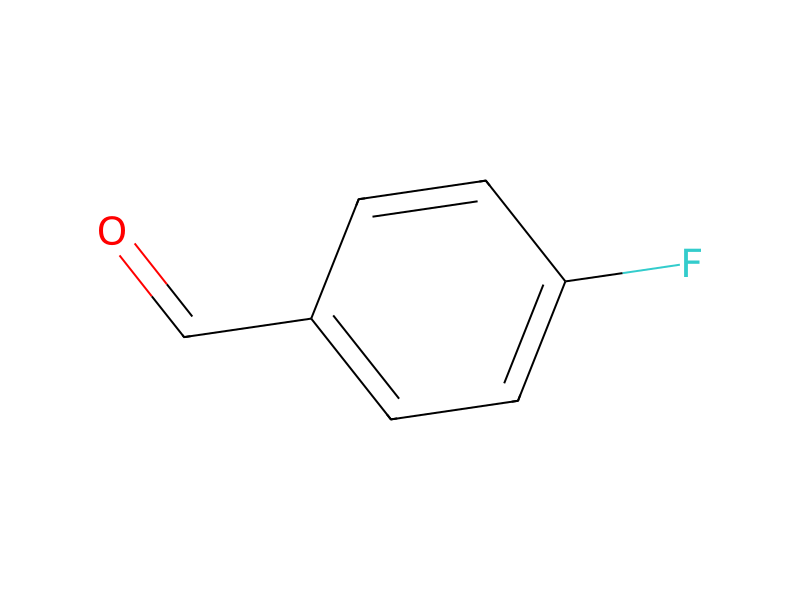
Product 1

Reagents, catalysts & solvents 1

Procedure
There was added 41.5 grams (0.30 mole) of anhydrous potassium carbonate to a solution of 11 grams (0.10 mole) of hydroquinone, 24.8 grams (0.20 mole) of 4-fluorobenzaldehyde and 200 ml of dimethylacetamide. The resulting solution was heated at reflux for 12 hours. The reaction mixture was then decanted from the insoluble potassium salts and allowed to cool. The cooled solution was added to water to effect precipitation of product which was isolated by filtration. The product was recrystallized from isopropanol/water to yield 21 grams (66%) of 4,4'[1,4-phenylenebis(oxy)]bisbenzaldehyde having a melting point of 157°-158° C. The identity of the product was further confirmed by proton NMR.
Workup
- temperatureThe resulting solution was heated
- temperatureat reflux for 12 hours
- customThe reaction mixture was then decanted from the insoluble potassium salts
- temperatureto cool
- additionThe cooled solution was added to water
- customprecipitation of product which
- customwas isolated by filtration
- customThe product was recrystallized from isopropanol/water
Sources & evidence
- ORD record
- ord-2832d4cddda6429fadc9a164b565c8b4
- Source dataset
- uspto-grants-1989_10
- Patent number
- US04873371
Reaction notes
Loading…