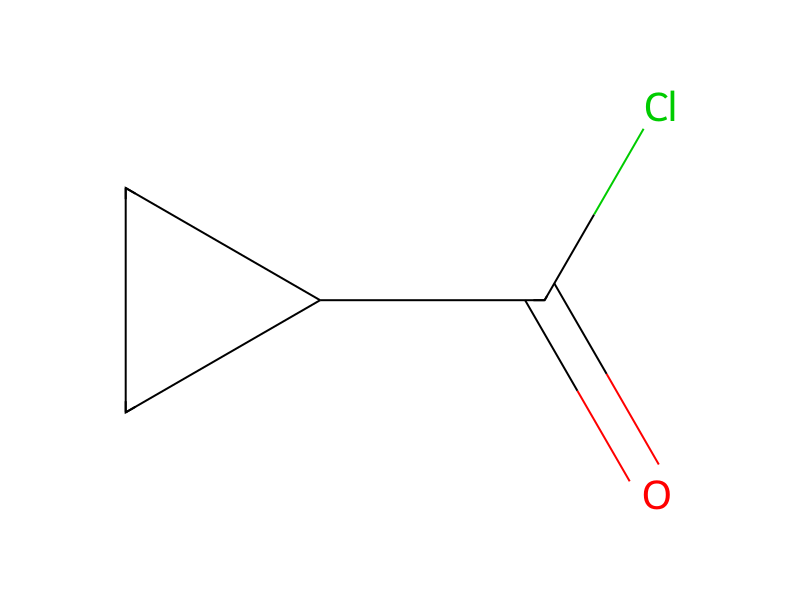
Cyclopropanecarbonyl chloride → 2-Chloro-6-(cyclopropylcarbonyl)-5,6,7,8-tetrahydro-1,6-naphthyridine
Reaction equation

Cl.[Cl:2][C:3]1[CH:12]=[CH:11][C:10]2[CH2:9][NH:8][CH2:7][CH2:6][C:5]=2[N:4]=1.CCN(C(C)C)C(C)C.[CH:22]1([C:25](Cl)=[O:26])[CH2:24][CH2:23]1>ClCCl.Cl>[Cl:2][C:3]1[CH:12]=[CH:11][C:10]2[CH2:9][N:8]([C:25]([CH:22]3[CH2:24][CH2:23]3)=[O:26])[CH2:7][CH2:6][C:5]=2[N:4]=1Participants
6
Reactant 3


Product 1

Reagents, catalysts & solvents 2


Procedure
To a room temperature stirred suspension of 2-chloro-5,6,7,8-tetrahydro-1,6-naphthyridine hydrochloride (50 mg, 0.24 mmol) in dichloromethane (2 ml) under a nitrogen atmosphere was added DIPEA (0.12 ml, 0.73 mmol) followed by cyclopropyl carbonyl chloride (24 μl, 0.27 mmol). The resulting mixture was stirred for 16 hours, diluted with dichloromethane (30 ml) and 1M aq. HCl (2 ml). The organic layer was separated and washed with saturated aqueous NaHCO3 (15 ml) and brine (15 ml), dried (MgSO4), filtered and concentrated at reduced pressure to provide the title compound (60 mg, 95%) which was used without further purification.
Workup
- stirringThe resulting mixture was stirred for 16 hours
- customThe organic layer was separated
- washwashed with saturated aqueous NaHCO3 (15 ml) and brine (15 ml)
- dry with materialdried (MgSO4)
- filtrationfiltered
- concentrationconcentrated at reduced pressure
Sources & evidence
- ORD record
- ord-0216f6721ccf4d0da782bd4c37e3b266
- Source dataset
- uspto-grants-2014_04
- Patent number
- US08691804B2
Reaction notes
Loading…