Water → 1-(2-(pyrrolidin-1-yl)ethyl)-4-(4,4,5,5-tetramethyl-1,3,2-dioxaborolan-2-yl)-1H-pyrazole
Reaction equation

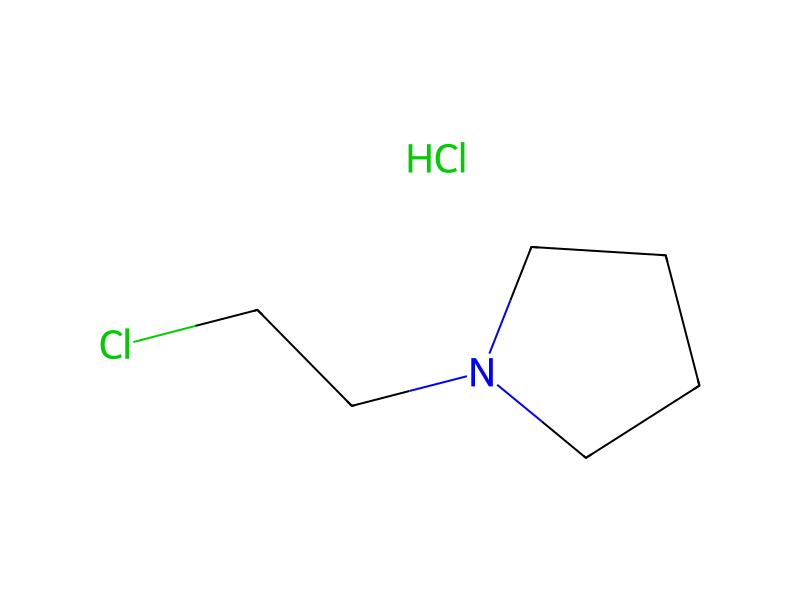
[H-].[Na+].[CH3:3][C:4]1([CH3:16])[C:8]([CH3:10])([CH3:9])[O:7][B:6]([C:11]2[CH:12]=[N:13][NH:14][CH:15]=2)[O:5]1.Cl.Cl[CH2:19][CH2:20][N:21]1[CH2:25][CH2:24][CH2:23][CH2:22]1.O>CN(C)C=O.C(OCC)(=O)C>[N:21]1([CH2:20][CH2:19][N:14]2[CH:15]=[C:11]([B:6]3[O:7][C:8]([CH3:9])([CH3:10])[C:4]([CH3:16])([CH3:3])[O:5]3)[CH:12]=[N:13]2)[CH2:25][CH2:24][CH2:23][CH2:22]1Participants
Reactant 4



Product 1

Reagents, catalysts & solvents 2


Procedure
To a suspension of sodium hydride (0.272 g, 11.34 mmol) in N,N-dimethylformamide (13 mL) was added 4-(4,4,5,5-tetramethyl-1,3,2-dioxaborolan-2-yl)-1H-pyrazole (1.0 g, 5.15 mmol) and 2-chloroethylpyrrolidine HCl salt (0.964 g, 5.67 mmol) as solutions in N,N-dimethylformamide (2 mL each). The reaction was stirred at room temperature for 0.5 hours and then heated to 65° C. for 3 hours. The reaction was cooled to room temperature and diluted with ethyl acetate (50 mL). Water (50 mL) was added, and the layers were separated. The aqueous layer was extracted with additional ethyl acetate (2×30 mL). The combined organics were washed with water, dried with anhydrous sodium sulfate, filtered and concentrated under reduced pressure to give the title compound, which was used without further purification. MS ESI(+) m/z 292.2 [M+H]+;
Workup
- temperatureheated to 65° C. for 3 hours
- temperatureThe reaction was cooled to room temperature
- customthe layers were separated
- extractionThe aqueous layer was extracted with additional ethyl acetate (2×30 mL)
- washThe combined organics were washed with water
- dry with materialdried with anhydrous sodium sulfate
- filtrationfiltered
- concentrationconcentrated under reduced pressure
Sources & evidence
- ORD record
- ord-5df25dd0e67a42579686413a5de6775e
- Source dataset
- uspto-grants-2014_04
- Patent number
- US08691810B2
Reaction notes
Loading…