Potassium Carbonate → HCID 66960277, compound
Reaction equation

C(OC(C1C=CC(B(O)O)=CC=1)=O)C.NC1CC(C(N(CCC)CCC)=O)=CC2C=CC(Br)=CC=2N=1.COC(C1C=CC(B(O)O)=CC=1)=O.C(=O)([O-])[O-].[K+].[K+].[C:56]([O:60][C:61]([NH:63][C:64]1[CH2:65][C:66]([C:86](=[O:102])[N:87]([CH2:91][CH2:92][CH2:93][O:94][Si:95]([C:98]([CH3:101])([CH3:100])[CH3:99])([CH3:97])[CH3:96])[CH2:88][CH2:89][CH3:90])=[CH:67][C:68]2[CH:74]=[CH:73][C:72]([C:75]3[CH:85]=[CH:84][C:78]([C:79]([O:81][CH2:82][CH3:83])=[O:80])=[CH:77][CH:76]=3)=[CH:71][C:69]=2[N:70]=1)=[O:62])([CH3:59])([CH3:58])[CH3:57]>C(#N)C.CCOC(C)=O.ClCCl.C(O)(C(F)(F)F)=O.C1C=CC([P]([Pd]([P](C2C=CC=CC=2)(C2C=CC=CC=2)C2C=CC=CC=2)([P](C2C=CC=CC=2)(C2C=CC=CC=2)C2C=CC=CC=2)[P](C2C=CC=CC=2)(C2C=CC=CC=2)C2C=CC=CC=2)(C2C=CC=CC=2)C2C=CC=CC=2)=CC=1>[NH2:63][C:64]1[CH2:65][C:66]([C:86]([N:87]([CH2:91][CH2:92][CH2:93][OH:94])[CH2:88][CH2:89][CH3:90])=[O:102])=[CH:67][C:68]2[CH:74]=[CH:73][C:72]([C:75]3[CH:76]=[C:77]4[C:78](=[CH:84][CH:85]=3)[C:79](=[O:80])[O:81][CH2:82]4)=[CH:71][C:69]=2[N:70]=1.[C:56]([O:60][C:61]([NH:63][C:64]1[CH2:65][C:66]([C:86](=[O:102])[N:87]([CH2:91][CH2:92][CH2:93][O:94][Si:95]([C:98]([CH3:99])([CH3:101])[CH3:100])([CH3:96])[CH3:97])[CH2:88][CH2:89][CH3:90])=[CH:67][C:68]2[CH:74]=[CH:73][C:72]([C:75]3[CH:85]=[CH:84][C:78]([C:79]([O:81][CH2:82][CH3:83])=[O:80])=[CH:77][CH:76]=3)=[CH:71][C:69]=2[N:70]=1)=[O:62])([CH3:57])([CH3:58])[CH3:59]Participants
Reactant 5



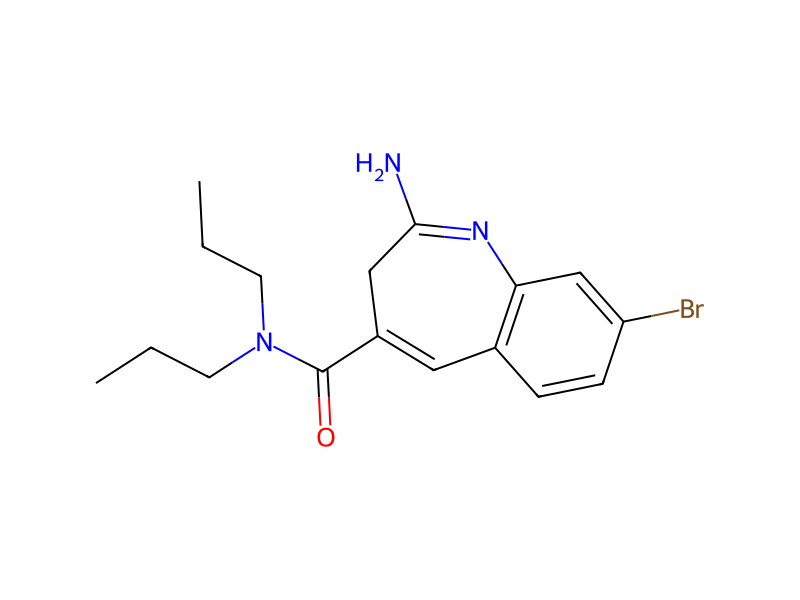
Product 2

Reagents, catalysts & solvents 5





Conditions
- Temperature
- 100 °C
Procedure
(1E,4E)-2-Amino-N-(3-hydroxypropyl)-8-(1-oxo-1,3-dihydroisobenzofuran-5-yl)-N-propyl-3H-benzo[b]azepine-4-carboxamide (33%) was prepared as follows, substituting 5-(4,4,5,5-tetramethyl-1,3,2-dioxaborolan-2-yl)isobenzofuran-1(3H)-one for 4-(ethoxycarbonyl)phenylboronic acid. Ethyl 4-((1E,4E)-2-(tert-butoxycarbonylamino)-4-((3-(tert-butyldimethylsilyloxy)propyl)(propyl)carbamoyl)-3H-benzo[b]azepin-8-yl)benzoate (44%) was prepared as follows, substituting tert-butyl (1E,4E)-8-bromo-4-((3-(tert-butyldimethylsilyloxy)propyl)(propyl)carbamoyl)-3H-benzo[b]azepin-2-ylcarbamate for 1E,4E)-2-amino-8-bromo-N,N-dipropyl-3H-benzo[b]azepine-4-carboxamide and 4-(ethoxycarbonyl)phenylboronic acid for 4-(methoxycarbonyl)phenylboronic acid. (1E,4E)-2-amino-8-bromo-N,N-dipropyl-3H-benzo[b]azepine-4-carboxamide (75.0 mgs, 0.206 mmol), 4-(methoxycarbonyl)phenylboronic acid (55.6 mgs, 0.309 mmol, tetrakis(triphenylphosphine)palladium(0) (23.8 mgs, 0.021 mmol), 2M aqueous potassium carbonate (0.309 ml, 0.618 mmol) were combined in 2 mls of acetonitrile in a microwave reaction vial. This mixture was heated in a microwave to 100° C. for 30 minutes. The mixture was then diluted with EtOAc, washed twice with brine, dried over sodium sulfate, and concentrated under reduced pressure. Preparative thin layer chromatography (2×0.5 mm plates, 7% MeOH/DCM) was then used. Ethyl 4-((1E,4E)-2-(tert-butoxycarbonylamino)-4-((3-(tert-butyldimethylsilyloxy)propyl)(propyl)carbamoyl)-3H-benzo[b]azepin-8-yl)benzoate (0.050 g, 0.075 mmol) was dissolved in 2 mls of dichloromethane and 0.5 ml of TFA. After about one hour, the mixture was concentrated under reduced pressure and the resulting residue was then re-dissolved in dichloromethane and 1 ml of concentrated ammonium hydroxide added and the mixture vigorously stirred for 15 minutes. This mixture was then diluted with water, extracted with dichloromethane (2×), extracts dried over sodium sulfate and concentrated under reduced pressure. Preparative thin layer chromatography (2×0.5 mm plates, 10% MeOH/DCM/0.5% NH4OH) was used. 1H NMR (400 MHz, CDCl3) δ 7.95-8.00 (m, 1H), 7.78-7.82 (m, 1H), 7.70-7.73 (m, 1H), 7.50-7.53 (m, 1H), 7.37-7.42 (m, 1H), 7.28-7.33 (m, 1H), 6.89 (s, 1H), 5.37 (s, 2H), 5.12 (br s, 1H), 3.58-3.71 (m, 4H), 3.43-3.55 (m, 3H), 2.82 (m, 2H), 1.79-1.88 (m, 2H), 1.64-1.77 (m, 2H), 0.90-0.99 (m, 3H); m/z (APCI-pos) M+1=434.2.
Workup
- washwashed twice with brine
- dry with materialdried over sodium sulfate
- concentrationconcentrated under reduced pressure
- concentrationthe mixture was concentrated under reduced pressure
- dissolutionthe resulting residue was then re-dissolved in dichloromethane
- addition1 ml of concentrated ammonium hydroxide added
- additionThis mixture was then diluted with water
- extractionextracted with dichloromethane (2×)
- dry with materialextracts dried over sodium sulfate
- concentrationconcentrated under reduced pressure
Sources & evidence
- ORD record
- ord-119fb39ab3f74a088f1fc407022fbdb2
- Source dataset
- uspto-grants-2014_04
- Patent number
- US08691809B2
Reaction notes
Loading…