Iodoethane → Methyl(1-ethylinden-3-yl)acetate
Reaction equation

[CH2:1]1[C:9]2[C:4](=[CH:5][CH:6]=[CH:7][CH:8]=2)[C:3]([CH2:10][C:11]([O:13][CH3:14])=[O:12])=[CH:2]1.[Li+].[CH3:16][CH:17]([N-]C(C)C)C.C(I)C>C1COCC1>[CH2:16]([CH:1]1[C:9]2[C:4](=[CH:5][CH:6]=[CH:7][CH:8]=2)[C:3]([CH2:10][C:11]([O:13][CH3:14])=[O:12])=[CH:2]1)[CH3:17]Participants
Reactant 3


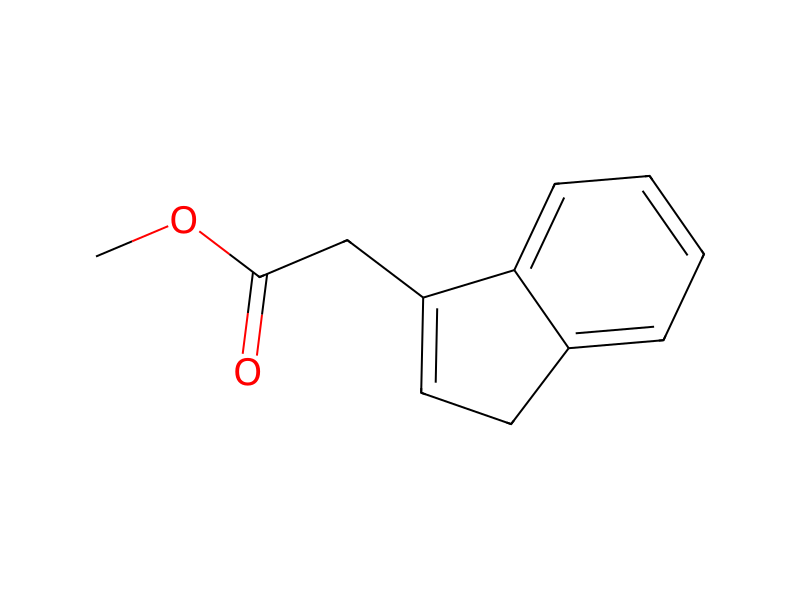
Product 1

Reagents, catalysts & solvents 1

Conditions
- Temperature
- -70 °C
Procedure
To a solution of methyl inden-3-ylacetate from Example 13, Step 1 (1 g, 5.32 mmol) in THF (10 mL) at -70° C. was added dropwise a solution of LDA (12.2 mL, 0.87M, 2 eq.) in THF. The resulting orange solution was stirred for 30 minutes at -70° C. and then ethyl iodide (0.47 mL, 5.85 mmol) was added dropwise. The cooling bath was removed and the reaction mixture was left to warm to room temperature while a precipitate appeared. The reaction mixture was then quenched with a saturated aqueous solution of ammonium chloride and extracted with ethyl acetate. The organic layer was washed with 1N HCl, then with brine, dried over MgSO4 and evaporated to dryness. The oily residue was chromatographed on silica gel eluting with a 1:19 mixture of ethyl acetate-hexane to afford pure title compound as an oil.
Workup
- customThe cooling bath was removed
- waitthe reaction mixture was left
- temperatureto warm to room temperature while a precipitate
- customThe reaction mixture was then quenched with a saturated aqueous solution of ammonium chloride
- extractionextracted with ethyl acetate
- washThe organic layer was washed with 1N HCl
- dry with materialwith brine, dried over MgSO4
- customevaporated to dryness
- customThe oily residue was chromatographed on silica gel eluting with a 1:19 mixture of ethyl acetate-hexane
Sources & evidence
- ORD record
- ord-c5d06bfef23a4c0c9ce01f9763c05e82
- Source dataset
- uspto-grants-1992_03
- Patent number
- US05093356
Reaction notes
Loading…