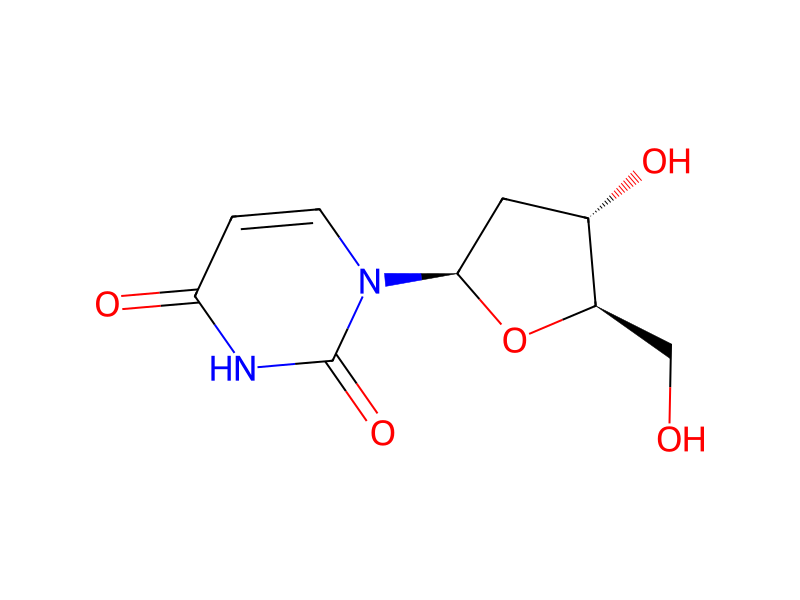
Hydrochloric Acid → Deoxyuridine
Reaction equation

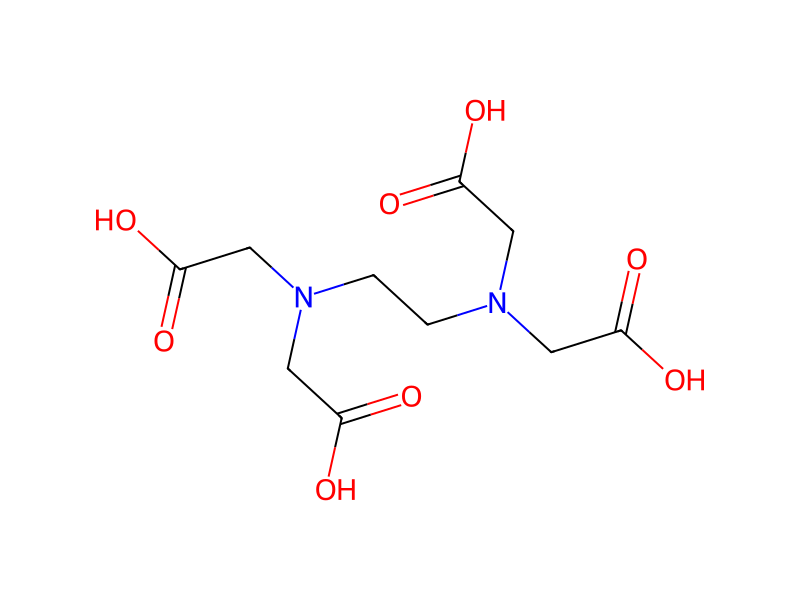
[C@@H:1]1([N:10]2[CH:17]=[CH:16][C:14](=[O:15])[NH:13][C:11]2=[O:12])[O:9][C@H:6]([CH2:7][OH:8])[C@@H:4]([OH:5])[C@H:2]1O.C(O)C(N)(CO)CO.Cl.C(N(CC(O)=O)CC(O)=O)CN(CC(O)=O)CC(O)=O>[Na+].[Cl-]>[C@@H:1]1([N:10]2[CH:17]=[CH:16][C:14](=[O:15])[NH:13][C:11]2=[O:12])[O:9][C@H:6]([CH2:7][OH:8])[C@@H:4]([OH:5])[CH2:2]1Participants
Reactant 4



Product 1
Reagents, catalysts & solvents 1

Conditions
- Temperature
- 90 °C
Procedure
The 1.5 kb EcoRI-BamHI fragment containing the B. amyloliquefaciens subtilisin gene (Wells et al., 1983) from pBO180 was cloned into M13mp11 to give M13mp11 SUBT essentially as previously described (Wells, J. A., et al. (1986) J. Biol. Chem., 2261,6564-6570). Deoxyuridine containing template DNA was prepared according to Kunkel (Kunkel, T. A. (1985) Proc. Natl. Acad. Sci. USA, 82 488-492). Uridine containing template DNA (Kunkel, 1985) was purified by CsCl density gradients (Maniatis, T. et al. (eds.) (1982) in Molecular Cloning, A Laboratory Manual, Cold Spring Harbor Laboratory, Cold Spring Harbor, N.Y.). A primer (AvaI) having the sequence ##STR5## ending at codon -11, was used to alter the unique AvaI recognition sequence within the subtilisin gene. (The asterisk denotes the mismatches from the wild-type sequence and underlined is the altered AvaI site.) The 5' phosphorylated AvaI primer (~320 pmol) and ~40 pmol (~120 μg) of uridine containing M13mp11 SUBT template in 1.88 ml of 53 mM NaCl, 7.4 mM MgC12 and 7.4 mM Tris.HCl (pH 7.5) were annealed by heating to 90° C. for 2 min. and cooling 15 min at 24° C. (FIG. 31). Primer extension at 24° C. was initiated by addition of 100 μL containing 1 mM in all four deoxynucleotide triphosphates, and 20 μl Klenow fragment (5 units/l). The extension reaction was stopped every 15 seconds over ten min by addition of 10 μl 0.25M EDTA (pH 8) to 50 μl aliquots of the reaction mixture. Samples were pooled, phenol chlorophorm extract and DNA was precipitated twice by addition of 2.5 vol 100% ethanol, and washed twice with 70% ethanol. The pellet was dried, and redissolved in 0.4 ml 1 mM EDTA, 10 mM Tris (pH 8). Misincorporation of α-thiodeoxynucleotides onto the 3' ends of the pool of randomly terminated template was carried out by incubating four 0.2 ml solutions each containing one-fourth of the randomly terminated template mixture (~20 μg), 0.25 mM of a given α-thiodeoxynucleotide triphosphate, 100 units AMV polymerase, 50 mM KCL, 10 mM MgCl2, 0.4 mM dithiothreitol, and 50 mM Tris (pH 8.3) (Champoux, J. J. (1984) Genetics, 2, 454-464). After incubation at 37° C. for 90 minutes, misincorporation reactions were sealed by incubation for five minutes at 37° C. with 50 mM all four deoxynucleotide triphosphates (pH 8), and 50 units AMV polymerase. Reactions were stopped by addition of 25 mM EDTA (final), and heated at 68° C. for ten min to inactivate AMV polymerase. After ethanol precipitation and resuspension, synthesis of closed circular heteroduplexes was carried out for two days at 14° C. under the same conditions used for the timed extension reactions above, except the reactions also contained 1000 units T4 DNA ligase, 0.5 mM ATP and 1 mM β-mercaptoethanol. Simultaneous restriction of each heteroduplex pool with KpnI, BamHI, and EcoRI confirmed that the extension reactions were nearly quantitative. Heteroduplex DNA in each reaction mixture was methylated by incubation with 80 μM S-adenosylmethionine and 150 units dam methylase for 1 hour at 37° C. Methylation reactions were stopped by heating at 68° C. for 15 min. One-half of each of the four methylated heteroduplex reactions were transformed into 2.5 ml competent E. coli JM101 (Messing, J. (1979) Recombinant DNA Tech. Bull., 2, 43-48). The number of independent transformants from each of the four transformations ranged from 0.4-2.0×10⁵. After growing out phage pools, RF DNA from each of the four transformations was isolated and purified by centrifugation through CsCl density gradients. Approximately 2 μg of RF DNA from each of the four pools was digested with EcoRI, BamHI and AvaI. The 1.5 kb EcoRI-BamHI fragment (i.e., AvaI resistant) was purified on low gel temperature agarose and ligated into the 5.5 kb EcoRI-BamHI vector fragment of pBO180. The total number of independent transformants from each α-thiodeoxynucleotide misincorporation plasmid library ranged from 1.2-2.4×10⁴. The pool of plasmids from each of the four transformations was grown out in 200 ml LB media containing 12.5 μg/ml cmp and plasmid DNA was purified by centrifugation through CsCl density gradients.
Workup
- additionThe 1.5 kb EcoRI-BamHI fragment containing the B
- customto give M13mp11 SUBT essentially
- customUridine containing template DNA (Kunkel, 1985) was purified by CsCl density gradients (Maniatis, T
- temperaturecooling 15 min at 24° C. (FIG. 31)
- additionPrimer extension at 24° C. was initiated by addition of 100 μL
- customThe extension reaction
- extractionphenol chlorophorm extract
- customDNA was precipitated twice by addition of 2.5 vol 100% ethanol
- washwashed twice with 70% ethanol
- customThe pellet was dried
- dissolutionredissolved in 0.4 ml 1 mM EDTA
- custommisincorporation reactions were sealed by incubation for five minutes at 37° C. with 50 mM all four deoxynucleotide triphosphates (pH 8), and 50 units AMV polymerase
- additionReactions were stopped by addition of 25 mM EDTA (final)
- temperatureheated at 68° C. for ten min to inactivate AMV polymerase
- customAfter ethanol precipitation and resuspension, synthesis of closed circular heteroduplexes
- waitwas carried out for two days at 14° C. under the same conditions
- waitHeteroduplex DNA in each reaction mixture was methylated by incubation with 80 μM S-adenosylmethionine and 150 units dam methylase for 1 hour at 37° C
- temperatureby heating at 68° C. for 15 min
- customwas isolated
- custompurified by centrifugation through CsCl density gradients
- customThe 1.5 kb EcoRI-BamHI fragment (i.e., AvaI resistant) was purified on low gel temperature agarose
- additioncontaining 12.5 μg/ml cmp
- customplasmid DNA was purified by centrifugation through CsCl density gradients
Sources & evidence
- ORD record
- ord-474860a8e4584cb5821d8466e1c5ead0
- Source dataset
- uspto-grants-1998_09
- Patent number
- US05801038
Reaction notes
Loading…