1,2,3,4-Tetrahydroisoquinoline → HCID 883945, compound
Reaction equation

FC(F)(F)C([N:5]1[CH2:13][CH2:12][CH:8]([C:9](O)=[O:10])[CH2:7][CH2:6]1)=O.[CH2:16]1[C:25]2[C:20](=[CH:21][CH:22]=[CH:23][CH:24]=2)[CH2:19][CH2:18][NH:17]1.CCN=C=NCCCN(C)C.C1C=CC2N(O)N=NC=2C=1.C(N(CC)CC)C.C([O-])([O-])=O.[K+].[K+]>ClCCl.CO>[CH2:16]1[C:25]2[C:20](=[CH:21][CH:22]=[CH:23][CH:24]=2)[CH2:19][CH2:18][N:17]1[C:9]([CH:8]1[CH2:12][CH2:13][NH:5][CH2:6][CH2:7]1)=[O:10]Participants
Reactant 6





Product 1

Reagents, catalysts & solvents 2


Procedure
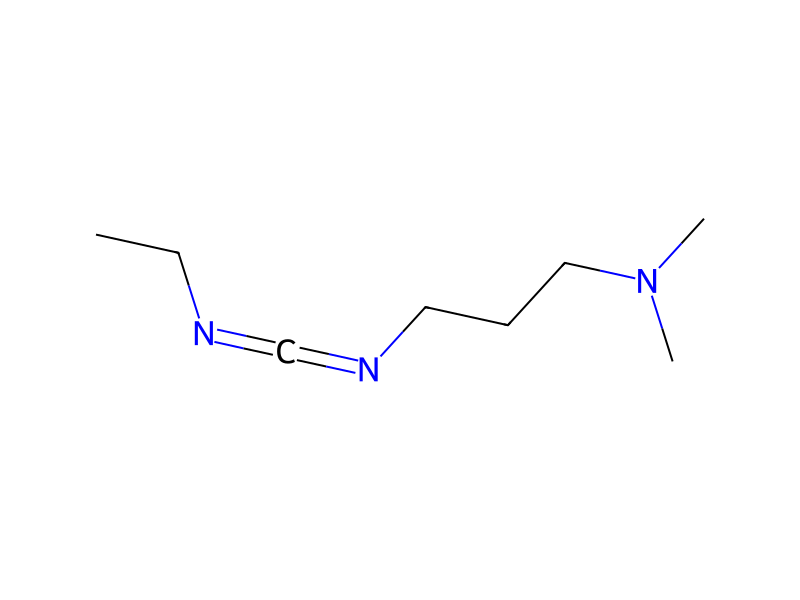
N-Trifluoroacetyl isonipecotic acid (2.56 g, 11.4 mmol), tetrahydroisoquinoline (1.82 g, 13.7 mmol), EDCI (2.63 g, 13.7 mmol), HOBT (1.85 g, 13.7 mmol) and triethylamine (1.38 g, 13.7 mmol) were stirred in dry dichloromethane (30 mL) at 25° C. for 6 h. The reaction was quenched with water and the aqueous phase was extracted with dichloromethane. The combined organic phase was dried over MgSO4 and purified by column chromatography (40/60 EtOAc/hexanes). The solid obtained was stirred with excess K2CO3 in MeOH at 25° C. overnight (16 h). After evaporation of MeOH, the residue was partitioned between dichloromethane and basic water. Evaporation of the organic phase gave pure product as a colorless solid (2.12 g, 76% for two steps). 1H NMR (CDCl3) (mixture of two rotamers) δ 7.23-7.16 (m, 4H), 4.73 (s, 1H), 4.67 (s, 1H), 3.83 (t, J=5.9 Hz, 1H), 3.74 (t, J=5.8 Hz, 1H), 3.21-3.16 (m, 2H), 2.92 (t, J=5.7 Hz, 1H), 2.85 (t, J=5.7 Hz, 1H), 2.76-2.67 (m, 3H), 2.29 (s, 1H), 1.80-1.73 (m, 4H); 13C NMR (CD3OD-CDCl3) δ 6 175.5, 175.3, 135.8, 135.1, 134.0, 133.8, 129.6, 129.3, 127.9, 127.6, 127.4, 127.3, 127.0, 48.2, 45.8, 45.4, 44.2, 41.4, 40.2, 39.6, 39.5, 30.5, 29.5, 29.4, 29.1; LRMS: m/z (relative intensity), 244 (M+, 37%), 188 (100%), 132 (74%); HRMS: calcd. for C15H19N2O 244.1576, found 244.1574. MP: 75-76° C.
Workup
- customThe reaction was quenched with water
- extractionthe aqueous phase was extracted with dichloromethane
- dry with materialThe combined organic phase was dried over MgSO4
- custompurified by column chromatography (40/60 EtOAc/hexanes)
- customThe solid obtained
- customAfter evaporation of MeOH
- customthe residue was partitioned between dichloromethane and basic water
- customEvaporation of the organic phase
Sources & evidence
- ORD record
- ord-635db036e26c4e18b8c538c2a5d41216
- Source dataset
- uspto-grants-2004_11
- Patent number
- US06825043B1
Reaction notes
Loading…