Trichloroacetyl chloride → 2-(Trichloroacetyl)pyrrole
Reaction equation

[Cl:1][C:2]([Cl:7])([Cl:6])[C:3](Cl)=[O:4].[NH:8]1[CH:12]=[CH:11][CH:10]=[CH:9]1.C(=O)([O-])[O-].[K+].[K+]>C(OCC)C.O>[Cl:1][C:2]([Cl:7])([Cl:6])[C:3]([C:9]1[NH:8][CH:12]=[CH:11][CH:10]=1)=[O:4]Participants
6
Reactant 3

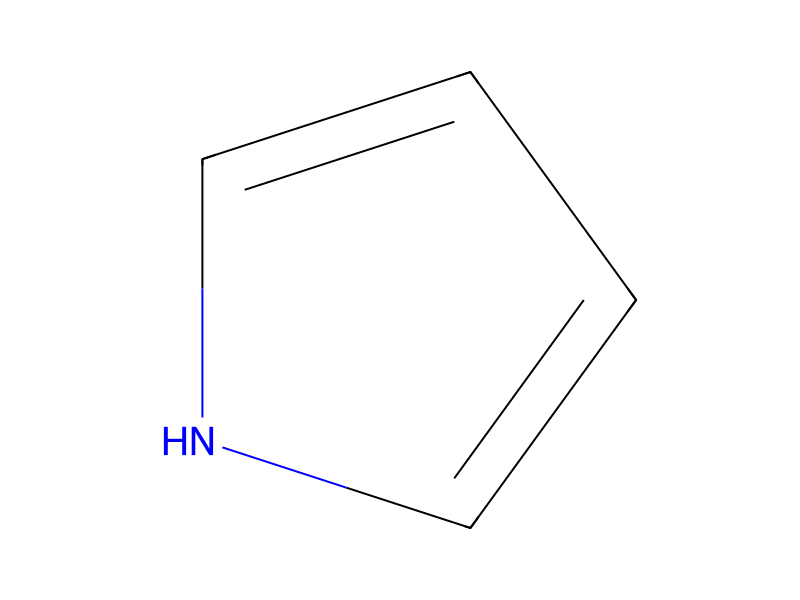

Product 1
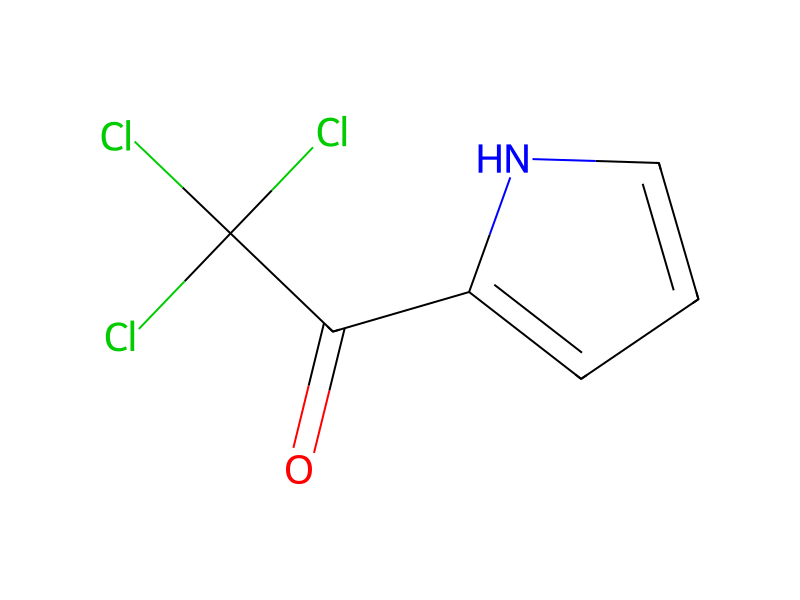
Reagents, catalysts & solvents 2


Procedure
To a solution of trichloroacetyl chloride (160.7 mmoles) in ethyl ether (26 ml) there is added, dropwise over a period of 3 hours, a solution of pyrrole (149 mmoles) in ethyl ether (83 ml). After stirring for a further hour, a solution of potassium carbonate (94 mmoles) in water (39 ml) is added dropwise. The phases are separated and the organic phase is dried over sodium sulphate and filtered. Active carbon is added to this organic phase. After stirring for 5 minutes, the organic phase is filtered and evaporated to dryness to yield the title product.
Workup
- customThe phases are separated
- dry with materialthe organic phase is dried over sodium sulphate
- filtrationfiltered
- additionActive carbon is added to this organic phase
- stirringAfter stirring for 5 minutes
- filtrationthe organic phase is filtered
- customevaporated to dryness
Sources & evidence
- ORD record
- ord-f6669ff6b5cc4f0f9fa81f8d0966424e
- Source dataset
- uspto-grants-2014_02
- Patent number
- US08653073B2
Reaction notes
Loading…