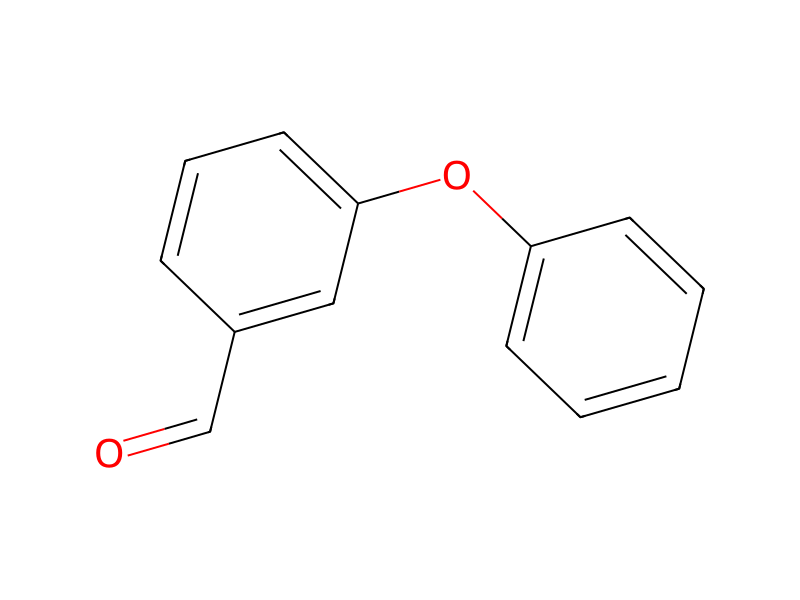
Hydrochloric Acid → 3-Phenoxybenzaldehyde
Reaction equation

[O:1]([C:8]1[CH:9]=[C:10]([CH:13]=[CH:14][CH:15]=1)[CH2:11]Cl)[C:2]1[CH:7]=[CH:6][CH:5]=[CH:4][CH:3]=1.[O:16](C1C=C(C=CC=1)C(Br)Br)C1C=CC=CC=1.C1N2CN3CN(C2)CN1C3.Cl>C(O)C.C(O)(=O)C>[O:1]([C:8]1[CH:9]=[C:10]([CH:13]=[CH:14][CH:15]=1)[CH:11]=[O:16])[C:2]1[CH:7]=[CH:6][CH:5]=[CH:4][CH:3]=1Participants
7





Procedure
A process according to claim 1, wherein the mixture of m-phenoxybenzyl bromide (II) and m-phenoxybenzal bromide (X = bromine) is reacted with 1 to 2 molar equivalents of hexamethylenetetramine in hot aqueous ethanol or hot aqueous acetic acid and hydrolyzing the mixture with dilute hydrochloric acid to yield m-phenoxybenzaldehyde (I).
Sources & evidence
- ORD record
- ord-71e851d97ae94812a875733e9d2fd1f2
- Source dataset
- uspto-grants-1978_08
- Patent number
- US04108904
Reaction notes
Loading…