Hydrochloric Acid → Tert-butyl 4-(2,2,2-trifluoroethyl)piperazine-1-carboxylate
Reaction equation
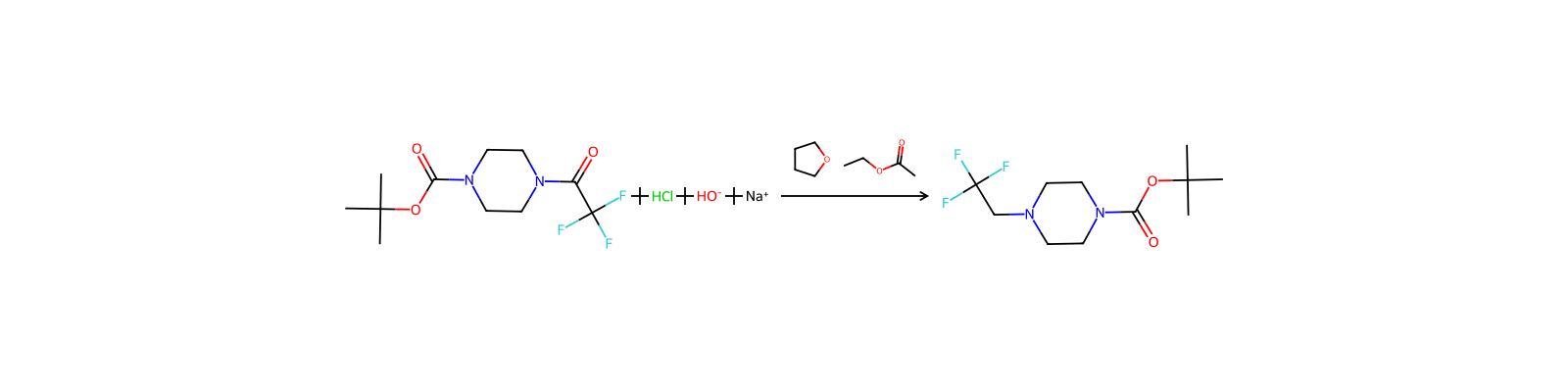
[F:1][C:2]([F:19])([F:18])[C:3]([N:5]1[CH2:10][CH2:9][N:8]([C:11]([O:13][C:14]([CH3:17])([CH3:16])[CH3:15])=[O:12])[CH2:7][CH2:6]1)=O.Cl.[OH-].[Na+]>O1CCCC1.C(OCC)(=O)C>[F:19][C:2]([F:1])([F:18])[CH2:3][N:5]1[CH2:6][CH2:7][N:8]([C:11]([O:13][C:14]([CH3:15])([CH3:16])[CH3:17])=[O:12])[CH2:9][CH2:10]1Participants
Reactant 3



Product 1

Reagents, catalysts & solvents 2


Procedure
tert-Butyl 4-(2,2,2-trifluoroacetyl)piperazine-1-carboxylate (0.908 g, 3.22 mmol) was added to a solution of borane-tetrahydrofuran complex (8 mmol) in tetrahydrofuran (24 mL) and the reaction mixture was heated at reflux for 2 h. After cooling, 2 N hydrochloric acid (4 mL) was carefully added and the reaction mixture was stirred until gas evolution ceased and then diluted with ethyl acetate (200 mL). Aqueous sodium hydroxide (0.2 M, 75 mL) was then added and the phases were separated. The organic layer was dried over sodium sulfate and evaporated. The residue was purified by column chromatography (eluting with 20% ethyl acetate in hexanes) to give tert-butyl 4-(2,2,2-trifluoroethyl)piperazine-1-carboxylate (0.627 g, 73%) as a white solid.
Workup
- temperaturethe reaction mixture was heated
- temperatureat reflux for 2 h
- temperatureAfter cooling
- customthe phases were separated
- dry with materialThe organic layer was dried over sodium sulfate
- customevaporated
- customThe residue was purified by column chromatography (eluting with 20% ethyl acetate in hexanes)
Sources & evidence
- ORD record
- ord-c341896ce28b411c9b5e36afc86e7c37
- Source dataset
- uspto-grants-2011_06
- Patent number
- US07964724B2
Reaction notes
Loading…