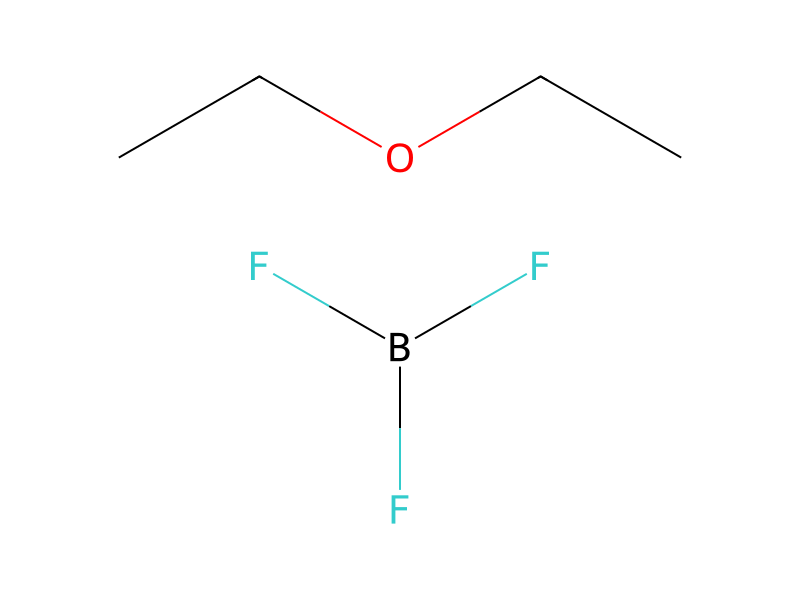
Boron trifluoride etherate → HCID 178505387, compound
Reaction equation

[NH2:1][C:2]1[C:3]([C:7]2[C:15]3[O:14][C:13]([F:17])([F:16])[O:12][C:11]=3[CH:10]=[CH:9][CH:8]=2)=[N:4][NH:5][CH:6]=1.[B:18]([F:21])([F:20])[F:19].CCOCC.[N:27](OC(C)(C)C)=O>C1COCC1.CCCCC.[Fe].Cl>[F:19][B-:18]([F:16])([F:21])[F:20].[F:16][C:13]1([F:17])[O:12][C:11]2[CH:10]=[CH:9][CH:8]=[C:7]([C:3]3[C:2]([N+:1]#[N:27])=[CH:6][NH:5][N:4]=3)[C:15]=2[O:14]1Participants



Conditions
- Temperature
- 0 °C
Procedure
3-(2,2-Difluoro-1,3-benzodioxol-4-yl)-4-nitropyrazole obtained above in Example 17 is reduced to 4-amino-3-(2,2-difluoro-1,3-benzodioxol-4yl)pyrazole according to the method described by Vogel (Practical Organic Chemistry, Fourth Edition p. 660: Fe/HCl). 0.8 g (0.003 mol) of 4-amino-3-(2,2-difluoro-1,3-benzodioxol-4-yl)pyrazole in solution in 10 ml of anhydrous THF is treated at 0° C. with a solution of 10 ml of THF-containing 1 ml (0.0081 mol) of boron trifluoride etherate. 0.6 ml (0.005 mol) of tert-butyl nitrite in solution in 5 ml of THF are then added to the reaction mixture. Stirring is maintained for 1 hour at 0° C., the reaction mixture is then diluted with pentane and filtered on a sintered glass. After drying, a beige powder is obtained.
Workup
- filtrationfiltered on a sintered glass
- customAfter drying
- customa beige powder is obtained
Sources & evidence
- ORD record
- ord-2cfb3708275249c39d9eb634bd280fd7
- Source dataset
- uspto-grants-1996_06
- Patent number
- US05523280
Reaction notes
Loading…