Triphenylphosphine → HCID 21466310, compound
Reaction equation

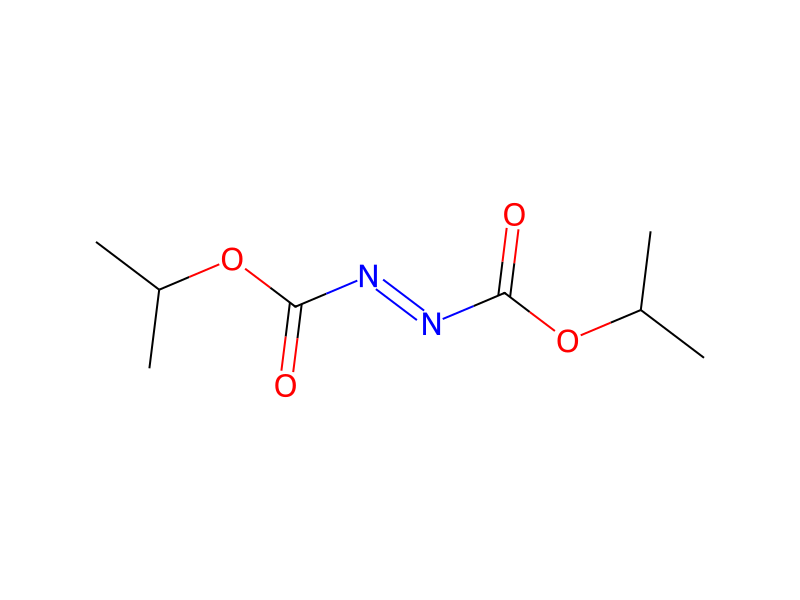
[F:1][C:2]([F:21])([F:20])[C:3]1[CH:8]=[C:7]([O:9][C:10]2[CH:15]=[CH:14][C:13]([O:16][CH2:17][CH3:18])=[CH:12][CH:11]=2)[CH:6]=[CH:5][C:4]=1[OH:19].[Br:22][C:23]([Br:27])=[CH:24][CH2:25]O.C1(P(C2C=CC=CC=2)C2C=CC=CC=2)C=CC=CC=1.CC(OC(/N=N/C(OC(C)C)=O)=O)C>O1CCCC1>[F:1][C:2]([F:20])([F:21])[C:3]1[CH:8]=[C:7]([O:9][C:10]2[CH:11]=[CH:12][C:13]([O:16][CH2:17][CH3:18])=[CH:14][CH:15]=2)[CH:6]=[CH:5][C:4]=1[O:19][CH2:25][CH:24]=[C:23]([Br:27])[Br:22]Participants
6




Procedure
To a solution prepared by dissolving 0.55 g of 2-trifluoromethyl-4-(4-ethoxyphenoxy)phenol, 0.40 g of 3,3-dibromoallyl alcohol and 0.49 g of triphenylphosphine in 10 ml of tetrahydrofuran, a solution prepared by dissolving 0.38 g of diisopropylazodicarboxylate in 5 ml of tetrahydrofuran was added dropwise at room temperature with stirring. After stirring at room temperature for 12 hours, the reaction solution was concentrated. Then, 20 ml of diethyl ether was added thereto, and the precipitate was filtered off. The resulting filtrate was concentrated, and subjected to silica gel column chromatography to give 0.30 g of 2-trifluoromethyl-4-(4-ethoxyphenoxy)-1-(3,3-dibromo-2-propenyloxy)benzene, yield 32%; nD24.0 1.5480.
Workup
- customTo a solution prepared
- customa solution prepared
- additionwas added dropwise at room temperature
- stirringAfter stirring at room temperature for 12 hours
- concentrationthe reaction solution was concentrated
- additionThen, 20 ml of diethyl ether was added
- filtrationthe precipitate was filtered off
- concentrationThe resulting filtrate was concentrated
Sources & evidence
- ORD record
- ord-6827ffe57f97477a86c5bb36550099f2
- Source dataset
- uspto-grants-1996_06
- Patent number
- US05530015
Reaction notes
Loading…