Chlorotrimethylsilane → HCID 67483244, compound
Reaction equation

BrCCBr.C[Si](Cl)(C)C.[CH3:10][O:11][C:12](=[O:19])/[C:13](/I)=[CH:14]\[CH:15]([CH3:17])[CH3:16].[CH3:20][S:21]([C:24]1[CH:29]=[CH:28][C:27](Br)=[CH:26][CH:25]=1)(=[O:23])=[O:22].[Cl-].[NH4+]>O1CCCC1.[Zn].C1C=CC(/C=C/C(/C=C/C2C=CC=CC=2)=O)=CC=1.C1C=CC(/C=C/C(/C=C/C2C=CC=CC=2)=O)=CC=1.[Pd].C1(P(C2C=CC=CC=2)C2C=CC=CC=2)C=CC=CC=1>[CH3:10][O:11][C:12](=[O:19])/[C:13](/[C:27]1[CH:28]=[CH:29][C:24]([S:21]([CH3:20])(=[O:23])=[O:22])=[CH:25][CH:26]=1)=[CH:14]/[CH:15]([CH3:17])[CH3:16]Participants
Reactant 5





Product 1

Reagents, catalysts & solvents 4



Conditions
- Temperature
- 25 °C
Procedure
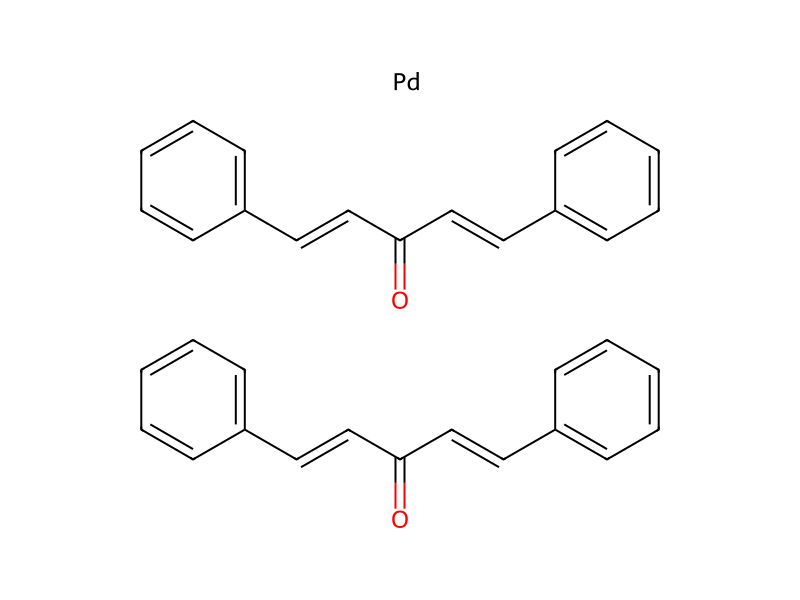
A mixture of zinc dust (1.71 g, 26 mmol, Aldrich, −325 mesh) and dry tetrahydrofuran (2 mL) under argon was treated with 1,2-dibromoethane (0.28 g, 1.5 mmol). The zinc suspension was then heated with a heat gun to ebullition, allowed to cool, and heated again. This process was repeated three times to make sure the zinc dust was activated. The activated zinc dust suspension was then treated with trimethylsilyl chloride (163 mg, 1.5 mmol), and the suspension was stirred for 15 min at 25° C. The reaction mixture was then treated dropwise with a solution of (E)-2-iodo-4-methyl-pentenoic acid methyl ester (2.22 g, 8.7 mmol) in dry tetrahydrofuran (3 mL) over 2 min. The reaction mixture was then stirred at 40-45° C. for 1 h and then stirred overnight at 25° C. The reaction mixture was then diluted with dry tetrahydrofuran (8 mL), and the stirring was stopped to allow the excess zinc dust to settle down (˜2 h). In a separate reaction flask, bis(dibenzylideneacetone)palladium(0) (81 mg, 0.15 mmol) and triphenylphosphine (156 mg, 0.6 mmol) in dry tetrahydrofuran (15 mL) was stirred at 25° C. under argon for 10 min and then treated with 4-bromophenyl methyl sulfone (1.64 g, 7 mmol) and the freshly prepared zinc compound in tetrahydrofuran. The resulting brick red solution was heated at 50° C. for 24 h. The reaction mixture was then cooled to 25° C. and then poured into a saturated aqueous ammonium chloride solution (100 mL), and the organic compound was extracted into ethyl acetate (3×50 mL). The combined organic extracts were washed with a saturated aqueous sodium chloride solution (1×100 mL), dried over anhydrous magnesium sulfate, filtered, and concentrated in vacuo. Biotage chromatography (FLASH 40M, Silica, 3/2 hexanes/ethyl acetate) afforded (E)-2-(4-(methanesulfonyl)-phenyl)-4-methyl-pentenoic acid methyl ester (1.876 g, 95%) as a viscous yellow oil: EI-HRMS m/e calcd for C14H18O4S (M+) 282.0926, found 282.0933.
Workup
- temperatureto cool
- temperatureheated again
- stirringThe reaction mixture was then stirred at 40-45° C. for 1 h
- stirringstirred overnight at 25° C
- custom(˜2 h)
- stirringwas stirred at 25° C. under argon for 10 min
- temperatureThe resulting brick red solution was heated at 50° C. for 24 h
- temperatureThe reaction mixture was then cooled to 25° C.
- extractionthe organic compound was extracted into ethyl acetate (3×50 mL)
- washThe combined organic extracts were washed with a saturated aqueous sodium chloride solution (1×100 mL)
- dry with materialdried over anhydrous magnesium sulfate
- filtrationfiltered
- concentrationconcentrated in vacuo
Sources & evidence
- ORD record
- ord-52870195b081415dba89b6903882976d
- Source dataset
- uspto-grants-2002_03
- Patent number
- US06353111B1
Reaction notes
Loading…